














A family of four foundation models designed to meet diverse enterprise needs across reasoning, multimodal processing, and real-time conversational AI.

How agentic systems work under the hood — and how AWS’s new AgentCore framework implements their essential components.

Reasoning models can generate seven to 10 times as many tokens as necessary on simple tasks, creating unsustainable costs at scale. Amazon's vision for metacognitive AI could fundamentally shift how models allocate computational resources.

Amazon's competitive-agent architecture creates a continuous improvement cycle that develops security protections at machine speed, reducing what typically takes weeks down to hours.


A new approach to reducing carbon emissions reveals previously hidden emission “hotspots” within value chains, helping organizations make more detailed and dynamic decisions about their future carbon footprints.
Customer-obsessed science


Research areas


-
 December 8, 20258 min readNew service lets customers mix their own data with the data used to train Amazon Nova at each major stage of model development, enabling deep domain understanding while preventing "catastrophic forgetting".
 -
 December 5, 20256 min read
 -
-
-
November 20, 20254 min read


Featured news
Initiative will fund over 100 doctoral students researching machine learning, computer vision, and natural-language processing at nine universities.
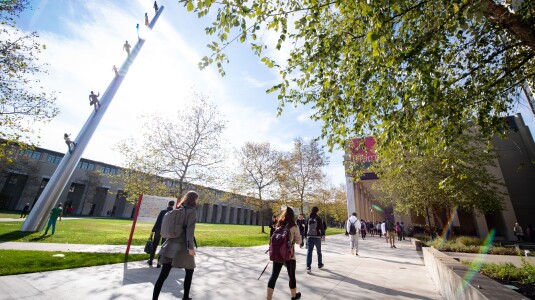
The collaboration will advance research in generative AI, robotics, natural language processing and cloud computing while fostering innovation in foundational and emerging technologies.
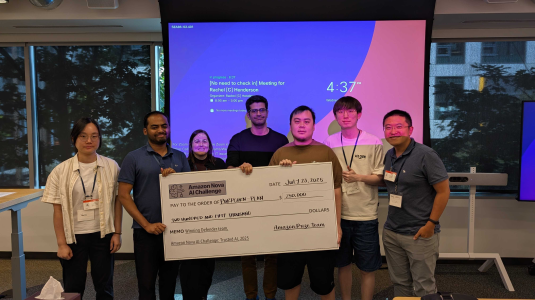
University teams battle to harden and hack AI coding assistants in head-to-head tournament

David Chang/Getty Images/iStockphoto
Led by David Luan and Pieter Abbeel, the lab will focus on developing new foundational capabilities for enabling useful AI agents.

The company's new state-of-the-art foundation models deliver frontier intelligence and industry-leading price performance.
-
Physical Review Letters2021We study the performance of classical and quantum machine learning (ML) models in predicting outcomes of physical experiments. The experiments depend on an input parameter x and involve execution of a (possibly unknown) quantum process E. Our figure of merit is the number of runs of E required to achieve a desired prediction performance. We consider classical ML models that perform a measurement and record
-
ICML 2021 Workshop on Uncertainty and Robustness in Deep Learning , NeurIPS 20212021Automatically detecting anomalies in event data can provide substantial value in domains such as healthcare, DevOps, and information security. In this paper, we frame the problem of detecting anomalous continuous-time event sequences as out-of-distribution (OoD) detection for temporal point processes (TPPs). We show how this problem can be approached using tools from the goodness-of-fit (GoF) testing literature
-
Physical Review A2021The promise of quantum computing with imperfect qubits relies on the ability of a quantum computing system to scale cheaply through error correction and fault tolerance. While fault tolerance requires relatively mild assumptions about the nature of qubit errors, the overhead associated with coherent and non-Markovian errors can be orders of magnitude larger than the overhead associated with purely stochastic
-
NeurIPS 20212021For supervised learning with tabular data, decision tree ensembles produced via boosting techniques generally dominate real-world applications involving iid training/test sets. However for graph data where the iid assumption is violated due to structured relations between samples, it remains unclear how to best incorporate this structure within existing boosting pipelines. To this end, we propose a generalized
-
NeurIPS 2021 Workshop on Efficient Natural Language and Speech Processing2021Training neural machine translation (NMT) models in federated learning (FL) settings could be inefficient both computationally and communication-wise, due to the large size of translation engines as well as the multiple rounds of updates required to train clients and a central server. In this paper, we explore how to efficiently build NMT models in an FL setup by proposing a novel solution. In order to
Collaborations
View allWhether you're a faculty member or student, there are number of ways you can engage with Amazon.
View all

Gretchen Ertl
The program offers unrestricted funds and other resources to support research at academic institutions and non-profit organizations in areas that align with our mission.
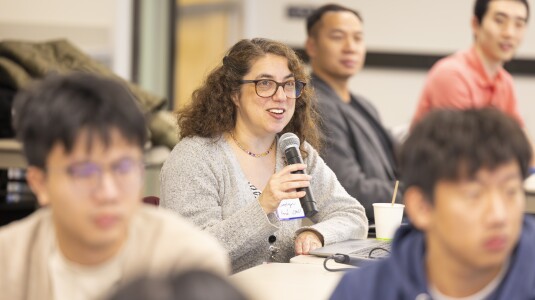
A global university competition to drive secure innovation in generative AI technology, which focuses on responsible AI and large language model coding security.

Credit: Wolfram Scheible
We partner with particular academic organizations across the world for deep and sustained collaborations in multiple research areas of mutual interest.
Courtesy of Pai-Ling Yin
We hire world-class academics to work on large-scale technical challenges, while they continue to teach and conduct research at their universities.

