














A family of four foundation models designed to meet diverse enterprise needs across reasoning, multimodal processing, and real-time conversational AI.

How agentic systems work under the hood — and how AWS’s new AgentCore framework implements their essential components.

Reasoning models can generate seven to 10 times as many tokens as necessary on simple tasks, creating unsustainable costs at scale. Amazon's vision for metacognitive AI could fundamentally shift how models allocate computational resources.

Amazon's competitive-agent architecture creates a continuous improvement cycle that develops security protections at machine speed, reducing what typically takes weeks down to hours.


A new approach to reducing carbon emissions reveals previously hidden emission “hotspots” within value chains, helping organizations make more detailed and dynamic decisions about their future carbon footprints.
Customer-obsessed science


Research areas


-
 December 5, 20256 min readA multiagent architecture separates data perception, tool knowledge, execution history, and code generation, enabling ML automation that works with messy, real-world inputs.
 -

-
-
November 20, 20254 min read
-
October 20, 20254 min read


Featured news
Initiative will fund over 100 doctoral students researching machine learning, computer vision, and natural-language processing at nine universities.

The collaboration will advance research in generative AI, robotics, natural language processing and cloud computing while fostering innovation in foundational and emerging technologies.
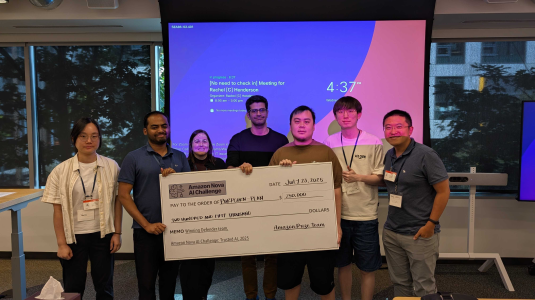
University teams battle to harden and hack AI coding assistants in head-to-head tournament

David Chang/Getty Images/iStockphoto
Led by David Luan and Pieter Abbeel, the lab will focus on developing new foundational capabilities for enabling useful AI agents.

The company's new state-of-the-art foundation models deliver frontier intelligence and industry-leading price performance.
-
ACL-IJCNLP 2021 Workshop on e-Commerce and NLP (ECNLP)2021Automatic Speech Recognition (ASR) robustness toward slot entities are critical in ecommerce voice assistants that involve monetary transactions and purchases. Along with effective domain adaptation, it is intuitive that cross utterance contextual cues play an important role in disambiguating domain specific content words from speech. In this paper, we investigate various techniques to improve contextualization
-
SIGIR 20212021Natural language query grounding in videos is a challenging task that requires comprehensive understanding of the query, video and fusion of information across these modalities. Existing methods mostly emphasize on the query-to-video one-way interaction with a late fusion scheme, lacking effective ways to capture the relationship within and between query and video in a fine-grained manner. Moreover, current
-
SIGIR 20212021We revisit the Bipartite Graph Partitioning approach to document reordering (Dhulipala et al., KDD 2016), and consider a range of algorithmic and heuristic refinements that lead to faster computation of index-minimizing document orderings. Our final implementation executes approximately four times faster than the reference implementation we commence with, and obtains the same, or slightly better, compression
-
ICML 20212021Current low-precision quantization algorithms often have the hidden cost of conversion back and forth from floating-point to quantized integer values. This hidden cost limits the latency improvement realized by quantizing Neural Networks. To address this, we present HAWQ-V3, a novel mixed-precision integer-only quantization framework. The contributions of HAWQ-V3 are the following: (i) An integer-only inference
-
ICML 20212021We study the identification of direct and indirect causes on time series with latent variables, and provide a constrained-based causal feature selection method, which we prove that is both sound and complete under some graph constraints. Our theory and estimation algorithm require only two conditional independence tests for each observed candidate time series to determine whether or not it is a cause of
Collaborations
View allWhether you're a faculty member or student, there are number of ways you can engage with Amazon.
View all

Gretchen Ertl
The program offers unrestricted funds and other resources to support research at academic institutions and non-profit organizations in areas that align with our mission.
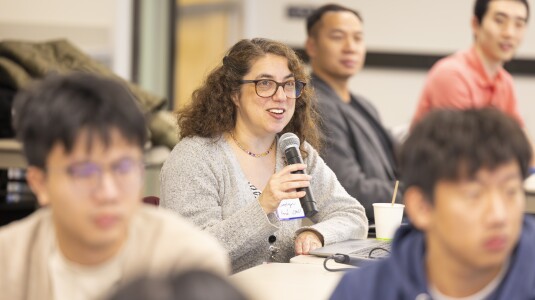
A global university competition to drive secure innovation in generative AI technology, which focuses on responsible AI and large language model coding security.

Credit: Wolfram Scheible
We partner with particular academic organizations across the world for deep and sustained collaborations in multiple research areas of mutual interest.
Courtesy of Pai-Ling Yin
We hire world-class academics to work on large-scale technical challenges, while they continue to teach and conduct research at their universities.

