














A family of four foundation models designed to meet diverse enterprise needs across reasoning, multimodal processing, and real-time conversational AI.

How agentic systems work under the hood — and how AWS’s new AgentCore framework implements their essential components.

Reasoning models can generate seven to 10 times as many tokens as necessary on simple tasks, creating unsustainable costs at scale. Amazon's vision for metacognitive AI could fundamentally shift how models allocate computational resources.

Amazon's competitive-agent architecture creates a continuous improvement cycle that develops security protections at machine speed, reducing what typically takes weeks down to hours.


A new approach to reducing carbon emissions reveals previously hidden emission “hotspots” within value chains, helping organizations make more detailed and dynamic decisions about their future carbon footprints.
Customer-obsessed science


Research areas


-
 December 1, 20258 min read“Network language models” will coordinate complex interactions among intelligent components, computational infrastructure, access points, data centers, and more.
 -

-
November 20, 20254 min read
-
October 20, 20254 min read
-
October 14, 20257 min read


Featured news
Initiative will fund over 100 doctoral students researching machine learning, computer vision, and natural-language processing at nine universities.

The collaboration will advance research in generative AI, robotics, natural language processing and cloud computing while fostering innovation in foundational and emerging technologies.
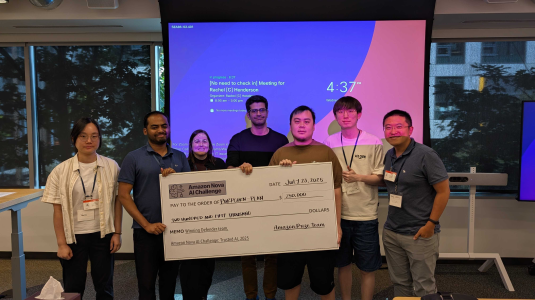
University teams battle to harden and hack AI coding assistants in head-to-head tournament

David Chang/Getty Images/iStockphoto
Led by David Luan and Pieter Abbeel, the lab will focus on developing new foundational capabilities for enabling useful AI agents.

The company's new state-of-the-art foundation models deliver frontier intelligence and industry-leading price performance.
-
ICASSP 20222022Maximum Likelihood Estimation (MLE) is currently the most common approach to train large scale speech recognition systems. While it has significant practical advantages, MLE exhibits several drawbacks known in literature: training and inference conditions are mismatched and a proxy objective is optimized instead of word error rate. Recently, the Optimal Completion Distillation (OCD) training method was
-
ICASSP 20222022Recent advances in deep learning have drastically improved performance on many Natural Language Understanding (NLU) tasks. However, the data used to train NLU models may contain private information such as addresses or phone numbers, particularly when drawn from human subjects. It is desirable that underlying models do not expose private information contained in the training data. Differentially Private
-
ICASSP 20222022Training speaker-discriminative and robust speaker verification systems without speaker labels is still challenging and worthwhile to explore. In this study, we propose an effective self-supervised learning framework and a novel regularization strategy to facilitate self-supervised speaker representation learning. Different from contrastive learning-based self-supervised learning methods, the proposed self-supervised
-
CHIIR 20222022Explanations describe product recommendations in a human interpretable way in order to achieve a goal, e.g. persuade users to buy. Unlike web product search, where users have access to diverse information as to why the products might be suitable for their needs, in the voice product search domain the amount of information that can be disclosed is inherently limited. Users in general evaluate a maximum of
-
AISTATS 20222022Machine learning classifiers rely on loss functions for performance evaluation, often on a private (hidden) dataset. In a recent line of research, label inference was introduced as the problem of reconstructing the ground truth labels of this private dataset from just the (possibly perturbed) cross-entropy loss function values evaluated at chosen prediction vectors (without any other access to the hidden
Collaborations
View allWhether you're a faculty member or student, there are number of ways you can engage with Amazon.
View all

Gretchen Ertl
The program offers unrestricted funds and other resources to support research at academic institutions and non-profit organizations in areas that align with our mission.
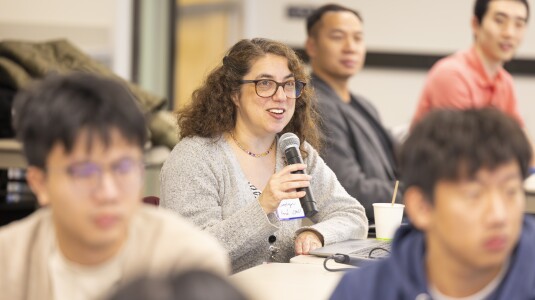
A global university competition to drive secure innovation in generative AI technology, which focuses on responsible AI and large language model coding security.

Credit: Wolfram Scheible
We partner with particular academic organizations across the world for deep and sustained collaborations in multiple research areas of mutual interest.

Courtesy of Pai-Ling Yin
We hire world-class academics to work on large-scale technical challenges, while they continue to teach and conduct research at their universities.

