














A family of four foundation models designed to meet diverse enterprise needs across reasoning, multimodal processing, and real-time conversational AI.

How agentic systems work under the hood — and how AWS’s new AgentCore framework implements their essential components.

Reasoning models can generate seven to 10 times as many tokens as necessary on simple tasks, creating unsustainable costs at scale. Amazon's vision for metacognitive AI could fundamentally shift how models allocate computational resources.

Amazon's competitive-agent architecture creates a continuous improvement cycle that develops security protections at machine speed, reducing what typically takes weeks down to hours.


A new approach to reducing carbon emissions reveals previously hidden emission “hotspots” within value chains, helping organizations make more detailed and dynamic decisions about their future carbon footprints.
Customer-obsessed science


Research areas


-
 December 1, 20258 min read“Network language models” will coordinate complex interactions among intelligent components, computational infrastructure, access points, data centers, and more.
 -

-
November 20, 20254 min read
-
October 20, 20254 min read
-
October 14, 20257 min read


Featured news
Initiative will fund over 100 doctoral students researching machine learning, computer vision, and natural-language processing at nine universities.
The collaboration will advance research in generative AI, robotics, natural language processing and cloud computing while fostering innovation in foundational and emerging technologies.
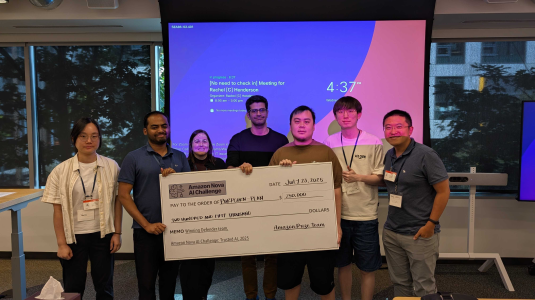
University teams battle to harden and hack AI coding assistants in head-to-head tournament

David Chang/Getty Images/iStockphoto
Led by David Luan and Pieter Abbeel, the lab will focus on developing new foundational capabilities for enabling useful AI agents.

The company's new state-of-the-art foundation models deliver frontier intelligence and industry-leading price performance.
-
ACL 20222022Several methods have been proposed for classifying long textual documents using Transformers. However, there is a lack of consensus on a benchmark to enable a fair comparison among different approaches. In this paper, we provide a comprehensive evaluation of the relative efficacy measured against various baselines and diverse datasets — both in terms of accuracy as well as time and space overheads. Our
-
AISTATS 20222022This paper studies the item-to-item recommendation problem in recommender systems from a new perspective of metric learning via implicit feedback. We develop and investigate a personalizable deep metric model that captures both the internal contents of items and how they were interacted with by users. There are two key challenges in learning such model. First, there is no explicit similarity annotation,
-
ICLR 20222022Existing domain adaptation methods tend to treat every domain equally and align them all perfectly. Such uniform alignment ignores topological structures among different domains; therefore it may be beneficial for nearby domains, but not necessarily for distant domains. In this work, we relax such uniform alignment by using a domain graph to encode domain adjacency, e.g., a graph of states in the US with
-
ICLR 20222022In NLP, a large volume of tasks involve pairwise comparison between two sequences (e.g., sentence similarity and paraphrase identification). Predominantly, two formulations are used for sentence-pair tasks: bi-encoders and cross-encoders. Bi-encoders produce fixed-dimensional sentence representations and are computationally efficient, however, they usually underperform cross-encoders. Cross-encoders can
-
The Web Conference 20222022Product search engines like Amazon Search often use caches to improve the customer user experience; caches can improve both the system’s latency as well as search quality. However, as search traffic increases over time, the cache’s ever-growing size can diminish the overall system performance. Furthermore, typos, misspellings, and redundancy widely witnessed in real-world product search queries can cause
Collaborations
View allWhether you're a faculty member or student, there are number of ways you can engage with Amazon.
View all

Gretchen Ertl
The program offers unrestricted funds and other resources to support research at academic institutions and non-profit organizations in areas that align with our mission.
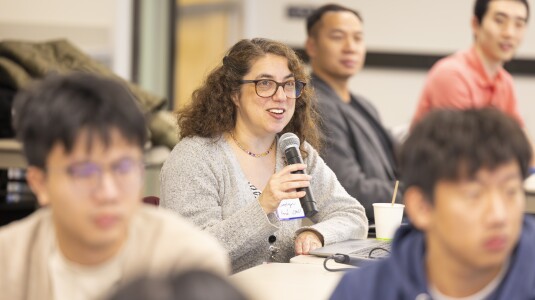
A global university competition to drive secure innovation in generative AI technology, which focuses on responsible AI and large language model coding security.

Credit: Wolfram Scheible
We partner with particular academic organizations across the world for deep and sustained collaborations in multiple research areas of mutual interest.
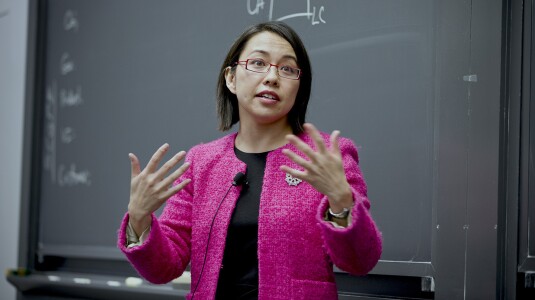
Courtesy of Pai-Ling Yin
We hire world-class academics to work on large-scale technical challenges, while they continue to teach and conduct research at their universities.

