














A family of four foundation models designed to meet diverse enterprise needs across reasoning, multimodal processing, and real-time conversational AI.

How agentic systems work under the hood — and how AWS’s new AgentCore framework implements their essential components.

Reasoning models can generate seven to 10 times as many tokens as necessary on simple tasks, creating unsustainable costs at scale. Amazon's vision for metacognitive AI could fundamentally shift how models allocate computational resources.

Amazon's competitive-agent architecture creates a continuous improvement cycle that develops security protections at machine speed, reducing what typically takes weeks down to hours.


A new approach to reducing carbon emissions reveals previously hidden emission “hotspots” within value chains, helping organizations make more detailed and dynamic decisions about their future carbon footprints.
Customer-obsessed science


Research areas


-
 December 1, 20258 min read“Network language models” will coordinate complex interactions among intelligent components, computational infrastructure, access points, data centers, and more.
 -

-
November 20, 20254 min read
-
October 20, 20254 min read
-
October 14, 20257 min read


Featured news
Initiative will fund over 100 doctoral students researching machine learning, computer vision, and natural-language processing at nine universities.
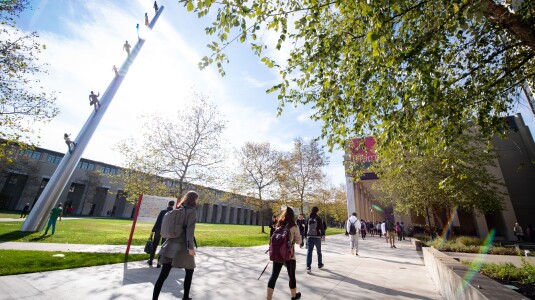
The collaboration will advance research in generative AI, robotics, natural language processing and cloud computing while fostering innovation in foundational and emerging technologies.
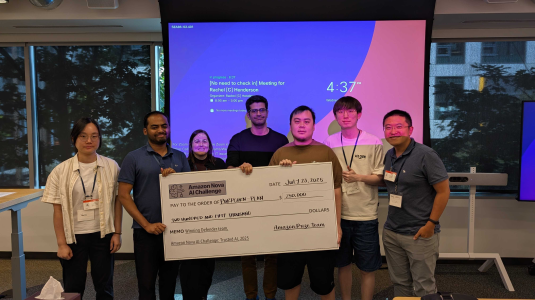
University teams battle to harden and hack AI coding assistants in head-to-head tournament

David Chang/Getty Images/iStockphoto
Led by David Luan and Pieter Abbeel, the lab will focus on developing new foundational capabilities for enabling useful AI agents.

The company's new state-of-the-art foundation models deliver frontier intelligence and industry-leading price performance.
-
NAACL 20222022Use of synthetic data is rapidly emerging as a realistic alternative to manually annotating real data for industry-scale model building. Manual data annotation is slow, expensive and not preferred for meeting customer privacy expectations. Further, commercial natural language applications are required to support continuously evolving features as well as newly added experiences. To address these requirements
-
ICASSP 20222022Improving end-to-end speech recognition by incorporating external text data has been a longstanding research topic. There has been a recent focus on training E2E ASR models that get the performance benefits of external text data without incurring the extra cost of evaluating an external language model at inference time. In this work, we propose training ASR model jointly with a set of text-to-text auxiliary
-
ICASSP 20222022Traditionally, research in automated speech recognition has focused on local-first encoding of audio representations to predict the spoken phonemes in an utterance. Unfortunately, approaches relying on such hyper-local information tend to be vulnerable to both local-level corruption (such as audio-frame drops, or loud noises) and global-level noise (such as environmental noise, or background noise) that
-
NAACL 20222022Despite recent improvements in abstractive summarization, most current approaches generate summaries that are not factually consistent with the source document, severely restricting their trust and usage in real-world applications. Recent works have shown promising improvements in factuality error identification using text or dependency arc entailments; however, they do not consider the entire semantic
-
NAACL 20222022Fine-tuning a pre-trained language model using annotated data has become the de-facto standard for adapting general-purpose pretrained models like BERT to downstream tasks. However, given the trend of larger pretrained models, fine-tuning these models for each downstream task is parameter-inefficient and computationally-expensive deeming this approach sub-optimal for adoption by NLU systems. In recent years
Collaborations
View allWhether you're a faculty member or student, there are number of ways you can engage with Amazon.
View all

Gretchen Ertl
The program offers unrestricted funds and other resources to support research at academic institutions and non-profit organizations in areas that align with our mission.
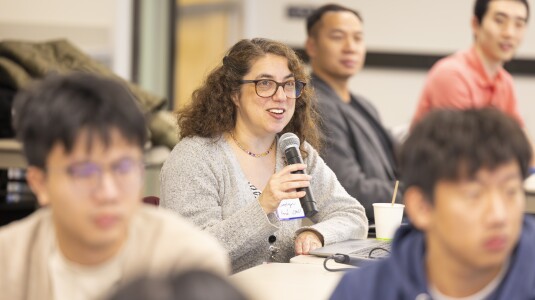
A global university competition to drive secure innovation in generative AI technology, which focuses on responsible AI and large language model coding security.

Credit: Wolfram Scheible
We partner with particular academic organizations across the world for deep and sustained collaborations in multiple research areas of mutual interest.
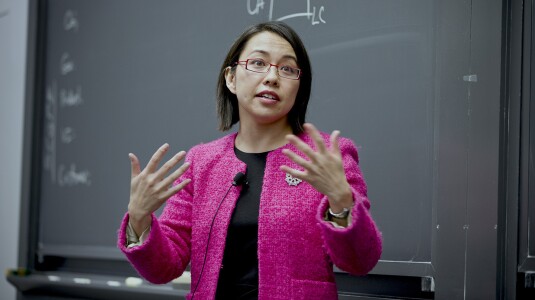
Courtesy of Pai-Ling Yin
We hire world-class academics to work on large-scale technical challenges, while they continue to teach and conduct research at their universities.

