














A family of four foundation models designed to meet diverse enterprise needs across reasoning, multimodal processing, and real-time conversational AI.

How agentic systems work under the hood — and how AWS’s new AgentCore framework implements their essential components.

Reasoning models can generate seven to 10 times as many tokens as necessary on simple tasks, creating unsustainable costs at scale. Amazon's vision for metacognitive AI could fundamentally shift how models allocate computational resources.

Amazon's competitive-agent architecture creates a continuous improvement cycle that develops security protections at machine speed, reducing what typically takes weeks down to hours.


A new approach to reducing carbon emissions reveals previously hidden emission “hotspots” within value chains, helping organizations make more detailed and dynamic decisions about their future carbon footprints.
Customer-obsessed science


Research areas


-
 December 5, 20256 min readA multiagent architecture separates data perception, tool knowledge, execution history, and code generation, enabling ML automation that works with messy, real-world inputs.
 -

-
-
November 20, 20254 min read
-
October 20, 20254 min read


Featured news
Initiative will fund over 100 doctoral students researching machine learning, computer vision, and natural-language processing at nine universities.

The collaboration will advance research in generative AI, robotics, natural language processing and cloud computing while fostering innovation in foundational and emerging technologies.
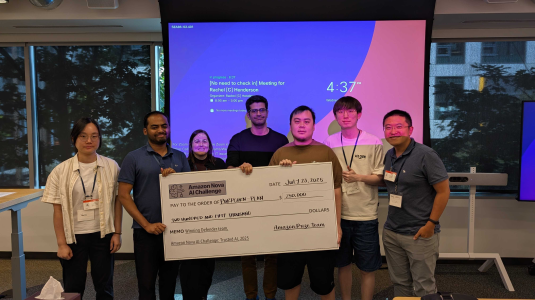
University teams battle to harden and hack AI coding assistants in head-to-head tournament

David Chang/Getty Images/iStockphoto
Led by David Luan and Pieter Abbeel, the lab will focus on developing new foundational capabilities for enabling useful AI agents.

The company's new state-of-the-art foundation models deliver frontier intelligence and industry-leading price performance.
-
CVPR 20212021In this paper, we investigate Universal Domain Adaptation (UniDA) problem, which aims to transfer the knowledge from source to target under unaligned label space. The main challenge of UniDA lies in how to separate common classes (i.e., classes shared across domains), from private classes (i.e., classes only exist in one domain). Previous works treat the private samples in the target as one generic class
-
ICASSP 20212021Deep learning is very data hungry, and supervised learning especially requires massive labeled data to work well. Machine listening research often suffers from limited labeled data problem, as human annotations are costly to acquire, and annotations for audio are time consuming and less intuitive. Besides, models learned from labeled dataset often embed biases specific to that particular dataset. Therefore
-
ACL Findings 20212021The performance of state-of-the-art neural rankers can deteriorate substantially when exposed to noisy inputs or applied to a new domain. In this paper, we present a novel method for fine-tuning neural rankers that can significantly improve their robustness to out-of-domain data and query perturbations. Specifically, a contrastive loss that compares data points in the representation space is combined with
-
KDD 20212021Abusive behavior in online retail websites and communities threatens the experience of regular community members. Such behavior often takes place within a complex, dynamic, and large-scale network of users interacting with items. Detecting abuse is challenging due to the scarcity of labeled abuse instances and complexity of combining temporal and network patterns while operating at a massive scale. Previous
-
ACL-IJCNLP 2021 Workshop on e-Commerce and NLP (ECNLP)2021Large-scale unsupervised abstractive summarization is sorely needed to automatically scan millions of customer reviews in today’s fast-paced e-commerce landscape. We address a key challenge in unsupervised abstractive summarization – reducing generic and uninformative content and producing useful information that relates to specific product aspects. To do so, we propose to model reviews in the context of
Collaborations
View allWhether you're a faculty member or student, there are number of ways you can engage with Amazon.
View all

Gretchen Ertl
The program offers unrestricted funds and other resources to support research at academic institutions and non-profit organizations in areas that align with our mission.
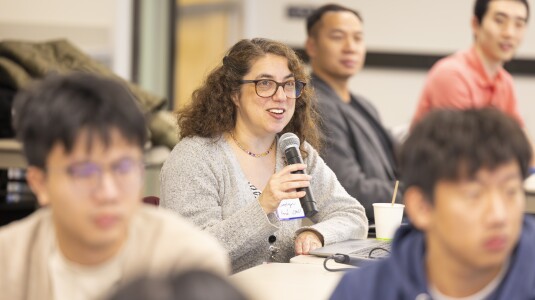
A global university competition to drive secure innovation in generative AI technology, which focuses on responsible AI and large language model coding security.

Credit: Wolfram Scheible
We partner with particular academic organizations across the world for deep and sustained collaborations in multiple research areas of mutual interest.
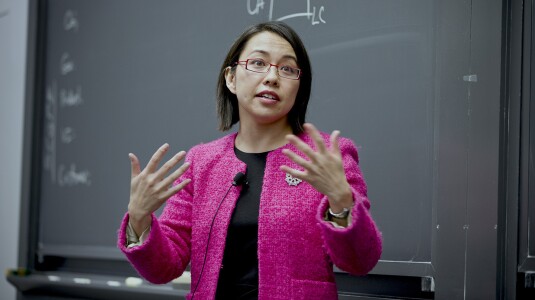
Courtesy of Pai-Ling Yin
We hire world-class academics to work on large-scale technical challenges, while they continue to teach and conduct research at their universities.

