













A family of four foundation models designed to meet diverse enterprise needs across reasoning, multimodal processing, and real-time conversational AI.

How agentic systems work under the hood — and how AWS’s new AgentCore framework implements their essential components.

Reasoning models can generate seven to 10 times as many tokens as necessary on simple tasks, creating unsustainable costs at scale. Amazon's vision for metacognitive AI could fundamentally shift how models allocate computational resources.

Amazon's competitive-agent architecture creates a continuous improvement cycle that develops security protections at machine speed, reducing what typically takes weeks down to hours.


A new approach to reducing carbon emissions reveals previously hidden emission “hotspots” within value chains, helping organizations make more detailed and dynamic decisions about their future carbon footprints.
Customer-obsessed science


Research areas


-
 December 5, 20256 min readA multiagent architecture separates data perception, tool knowledge, execution history, and code generation, enabling ML automation that works with messy, real-world inputs.
 -

-
-
November 20, 20254 min read
-
October 20, 20254 min read


Featured news
Initiative will fund over 100 doctoral students researching machine learning, computer vision, and natural-language processing at nine universities.
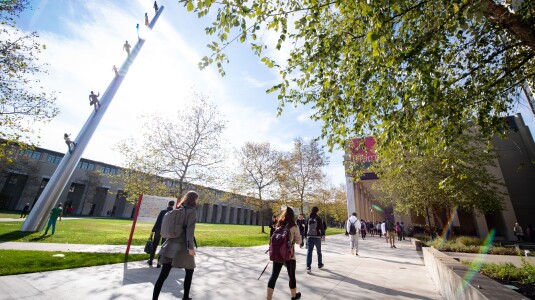
The collaboration will advance research in generative AI, robotics, natural language processing and cloud computing while fostering innovation in foundational and emerging technologies.
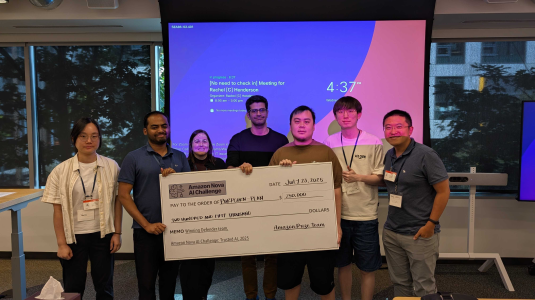
University teams battle to harden and hack AI coding assistants in head-to-head tournament

David Chang/Getty Images/iStockphoto
Led by David Luan and Pieter Abbeel, the lab will focus on developing new foundational capabilities for enabling useful AI agents.

The company's new state-of-the-art foundation models deliver frontier intelligence and industry-leading price performance.
-
AAAI 2021 Workshop on DSTC92021Most prior work on task-oriented dialogue systems are restricted to a limited coverage of domain APIs, while users oftentimes have domain related requests that are not covered by the APIs. This challenge track aims to expand the coverage of task-oriented dialogue systems by incorporating external unstructured knowledge sources. We define three tasks: knowledge-seeking turn detection, knowledge selection
-
Embedded World Exhibition & Conference 20212021FreeRTOS is a real-time kernel and set of libraries for Internet of Things (IoT) applications. The FreeRTOS kernel provides a portable abstraction layer, task scheduling and interprocess communication (IPC) mechanisms. The main IPC mechanism in FreeRTOS is a concurrent queue: a circular buffer data structure that tasks and interrupt service routines use to exchange messages. As a fundamental building block
-
ICML 20212021Despite the recent success of graph neural networks (GNN), common architectures often exhibit significant limitations, including sensitivity to over-smoothing, long-range dependencies, and spurious edges, e.g., as can occur as a result of graph heterophily or adversarial attacks. To at least partially address these issues within a simple transparent framework, we consider a new family of GNN layers designed
-
CVPR 2021 Fourth Workshop on Computer Vision for Fashion, Art and Design2021We present an end-to-end system for learning outfit recommendations. The core problem we address is how a customer can receive clothing/accessory recommendations based on a current outfit and what type of item the customer wishes to add to the outfit. Using a repository of coherent and stylish outfits, we leverage self-attention to learn a mapping from the current outfit and the customer-requested category
-
UAI 20212021Meta-learning learns across historical tasks with the goal to discover a representation from which it is easy to adapt to unseen tasks. Episodic meta-learning attempts to simulate a realistic setting by generating a set of small artificial tasks from a larger set of training tasks for meta-training and proceeds in a similar fashion for meta-testing. However, this (meta-)learning paradigm has recently been
Collaborations
View allWhether you're a faculty member or student, there are number of ways you can engage with Amazon.
View all

Gretchen Ertl
The program offers unrestricted funds and other resources to support research at academic institutions and non-profit organizations in areas that align with our mission.
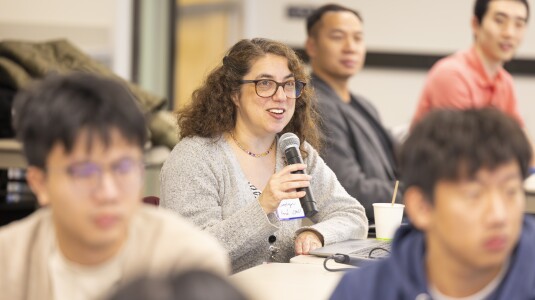
A global university competition to drive secure innovation in generative AI technology, which focuses on responsible AI and large language model coding security.

Credit: Wolfram Scheible
We partner with particular academic organizations across the world for deep and sustained collaborations in multiple research areas of mutual interest.
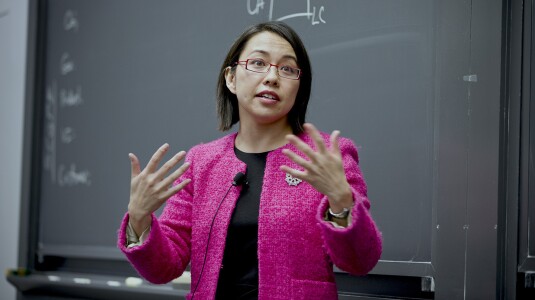
Courtesy of Pai-Ling Yin
We hire world-class academics to work on large-scale technical challenges, while they continue to teach and conduct research at their universities.

