














A family of four foundation models designed to meet diverse enterprise needs across reasoning, multimodal processing, and real-time conversational AI.

How agentic systems work under the hood — and how AWS’s new AgentCore framework implements their essential components.

Reasoning models can generate seven to 10 times as many tokens as necessary on simple tasks, creating unsustainable costs at scale. Amazon's vision for metacognitive AI could fundamentally shift how models allocate computational resources.

Amazon's competitive-agent architecture creates a continuous improvement cycle that develops security protections at machine speed, reducing what typically takes weeks down to hours.


A new approach to reducing carbon emissions reveals previously hidden emission “hotspots” within value chains, helping organizations make more detailed and dynamic decisions about their future carbon footprints.
Customer-obsessed science


Research areas


-
 December 1, 20258 min read“Network language models” will coordinate complex interactions among intelligent components, computational infrastructure, access points, data centers, and more.
 -

-
November 20, 20254 min read
-
October 20, 20254 min read
-
October 14, 20257 min read


Featured news
Initiative will fund over 100 doctoral students researching machine learning, computer vision, and natural-language processing at nine universities.
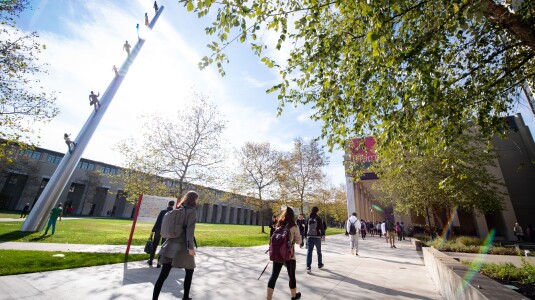
The collaboration will advance research in generative AI, robotics, natural language processing and cloud computing while fostering innovation in foundational and emerging technologies.
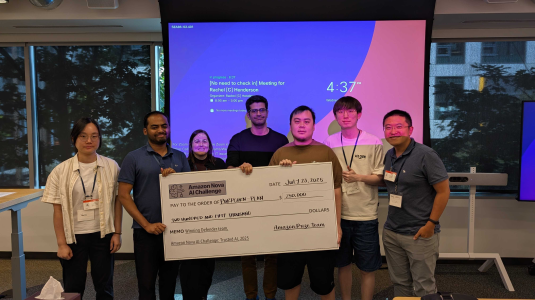
University teams battle to harden and hack AI coding assistants in head-to-head tournament

David Chang/Getty Images/iStockphoto
Led by David Luan and Pieter Abbeel, the lab will focus on developing new foundational capabilities for enabling useful AI agents.

The company's new state-of-the-art foundation models deliver frontier intelligence and industry-leading price performance.
-
AISTATS 20222022We propose Multivariate Quantile Function Forecaster (MQF2), a global probabilistic forecasting method constructed using a multivariate quantile function and investigate its application to multi-horizon forecasting. Prior approaches are either autoregressive, implicitly capturing the dependency structure across time but exhibiting error accumulation with increasing forecast horizons, or multi-horizon sequence-to-sequence
-
ICRA 20222022We approach instantaneous mapping, converting images to a top-down view of the world, as a translation problem. We show how a novel form of transformer network can be used to map from images and video directly to an overhead map or bird’s-eye-view (BEV) of the world, in a single end-to-end network. We assume a 1-1 correspondence between a vertical scanline in the image, and rays passing through the camera
-
AISTATS 20222022Quantile regression is an effective technique to quantify uncertainty, fit challenging underlying distributions, and often provide full probabilistic predictions through joint learnings over multiple quantile levels. A common drawback of these joint quantile regressions, however, is quantile crossing, which violates the desirable monotone property of the conditional quantile function. In this work, we propose
-
CODASPY 2022 International Workshop on Security and Privacy Analytics (IWSPA)2022Problem: Manual data analysis for extracting useful features in web log anomaly detection can be costly and time-consuming. Automated techniques on the other hand (e.g. Auto-Encoders and CNNs based) usually require supplemental network trainings for feature extractions. Often the systems trained on these features suffer from high False Positive Rates (FPRs) and rectifying them can negatively impact accuracies
-
The Web Conference 20222022Tree-based models underpin many modern semantic search engines and recommender systems due to their sub-linear inference times. In industrial applications, these models operate at extreme scales, where every bit of performance is critical. Memory constraints at extreme scales also require that models be sparse, hence tree-based models are often back-ended by sparse matrix algebra routines. However, there
Collaborations
View allWhether you're a faculty member or student, there are number of ways you can engage with Amazon.
View all

Gretchen Ertl
The program offers unrestricted funds and other resources to support research at academic institutions and non-profit organizations in areas that align with our mission.
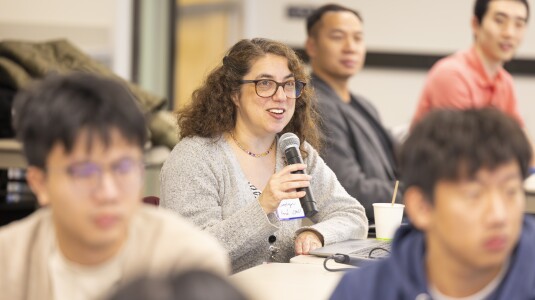
A global university competition to drive secure innovation in generative AI technology, which focuses on responsible AI and large language model coding security.
Credit: Wolfram Scheible
We partner with particular academic organizations across the world for deep and sustained collaborations in multiple research areas of mutual interest.
Courtesy of Pai-Ling Yin
We hire world-class academics to work on large-scale technical challenges, while they continue to teach and conduct research at their universities.

