














New audio-processing technology is making entertainment more accessible for millions of viewers.

Reasoning models can generate seven to 10 times as many tokens as necessary on simple tasks, creating unsustainable costs at scale. Amazon's vision for metacognitive AI could fundamentally shift how models allocate computational resources.

AGI SVP Rohit Prasad on how to mix your data with Amazon's training data at every stage — deep customization without catastrophic forgetting.

How agentic systems work under the hood — and how AWS’s new AgentCore framework implements their essential components.

Competitive-agent architecture develops security protections at machine speed, reducing weeks of work to hours.
Customer-obsessed science


Research areas


-
 December 5, 20256 min readA multiagent architecture separates data perception, tool knowledge, execution history, and code generation, enabling ML automation that works with messy, real-world inputs.
 -

-
-
November 20, 20254 min read
-


Featured news

Challenge pushes teams to demonstrate measurable gains in secure-coding performance while building AI agents that advance real-world utility and reliability at scale.

Meet the 63 Amazon Research Award (ARA) recipients, who represent 41 universities in 8 countries.
Initiative will fund over 100 doctoral students researching machine learning, computer vision, and natural-language processing at nine universities.

David Chang/Getty Images/iStockphoto
Led by David Luan and Pieter Abbeel, the lab will focus on developing new foundational capabilities for enabling useful AI agents.
-
IEEE Transactions on Neural Networks and Learning Systems2024Deep neural networks are becoming increasingly pervasive in academia and industry, matching and surpassing human performance on a wide variety of fields and related tasks. However, just as humans, even the largest artificial neural networks make mistakes, and once-correct predictions can become invalid as the world progresses in time. Augmenting datasets with samples that account for mistakes or up-to-date
-
2024Data deduplication is a critical task in data management and mining, focused on consolidating duplicate records that refer to the same entity. Personally Identifiable Information (PII) is a critical class of data for deduplication across various industries. Consumer data, stored and generated through various engagement channels, is crucial for marketers, agencies, and publishers. However, a major challenge
-
2024Using tools by Large Language Models (LLMs) is a promising avenue to extend their reach beyond language or conversational settings. The number of tools can scale to thousands as they enable accessing sensory information, fetching updated factual knowledge, or taking actions in the real world. In such settings, in-context learning by providing a short list of relevant tools in the prompt is a viable approach
-
NeurIPS 2024 Workshop on Bayesian Decision-making and Uncertainty2024Human coordination often benefits from executing actions in a correlated manner, leading to improved cooperation. This concept holds potential for enhancing cooperative multi-agent reinforcement learning (MARL). Despite this, recent advances in MARL predominantly focus on decentralized execution, which favors scalability by avoiding action correlation among agents. A recent study introduced a Bayesian network
-
2024Trained on vast corpora of human language, language models demonstrate emergent human-like reasoning abilities. Yet they are still far from true intelligence, which opens up intriguing opportunities to explore the parallels of humans and model behaviors. In this work, we study the ability to skip steps in reasoning—a hallmark of human expertise developed through practice. Unlike humans, who may skip steps
Collaborations
View allWhether you're a faculty member or student, there are number of ways you can engage with Amazon.
View all

Gretchen Ertl
The program offers unrestricted funds and other resources to support research at academic institutions and non-profit organizations in areas that align with our mission.
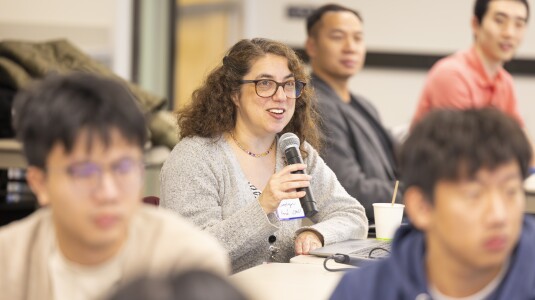
A global university competition to drive secure innovation in generative AI technology, which focuses on responsible AI and large language model coding security.

Credit: Wolfram Scheible
We partner with particular academic organizations across the world for deep and sustained collaborations in multiple research areas of mutual interest.
Courtesy of Pai-Ling Yin
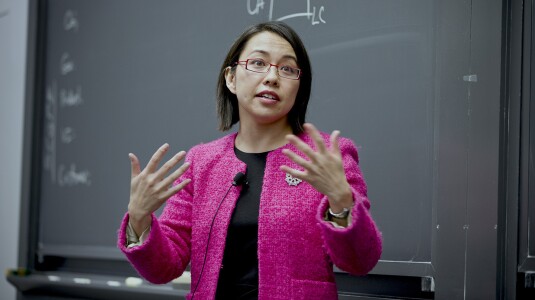
We hire world-class academics to work on large-scale technical challenges, while they continue to teach and conduct research at their universities.

