













"Reinforcement learning gyms" train agents on the many low-level tasks that they must chain together to execute customer requests.


From foundation model safety frameworks and formal verification at cloud scale to advanced robotics and multimodal AI reasoning, these are the most viewed publications from Amazon scientists and collaborators in 2025.


From quantum computing breakthroughs and foundation models for robotics to the evolution of Amazon Aurora and advances in agentic AI, these are the posts that captured readers' attention in 2025.
Customer-obsessed science


Research areas


-
 January 8, 20264 min readA new hybrid optimization approach allows edge devices to fine-tune vision-language models using only forward passes, achieving up to 7% higher accuracy than existing techniques.
 -
 December 10, 20255 min read
 -
December 8, 20258 min read
-
December 5, 20256 min read
-


Featured news

Hosted by Dr. Danielle Perszyk, cognitive scientist at Amazon's AGI Lab, the podcast features conversations with leading AI researchers about the breakthroughs needed to achieve general intelligence.

Challenge pushes teams to demonstrate measurable gains in secure-coding performance while building AI agents that advance real-world utility and reliability at scale.

Meet the 63 Amazon Research Award (ARA) recipients, who represent 41 universities in 8 countries.
Initiative will fund over 100 doctoral students researching machine learning, computer vision, and natural-language processing at nine universities.
-
2024This paper proposes the use of “multicalibration” to yield interpretable and reliable confidence scores for outputs generated by large language models (LLMs). Multicalibration asks for calibration not just marginally, but simultaneously across various intersecting groupings of the data. We show how to form groupings for prompt/completion pairs that are correlated with the probability of correctness via
-
2024Adapting large language models (LLMs) to unseen tasks with in-context training samples without fine-tuning remains an important research problem. To learn a robust LLM that adapts well to unseen tasks, multiple meta-training approaches have been proposed such as MetaICL and MetaICT, which involve meta-training pre-trained LLMs on a wide variety of diverse tasks. These meta-training approaches essentially
-
Tokenization matters: Navigating data-scarce tokenization for gender inclusive language technologies2024Gender-inclusive NLP research has documented the harmful limitations of gender binary-centric large language models (LLM), such as the inability to correctly use gender-diverse English neopronouns (e.g., xe, zir, fae). While data scarcity is a known culprit, the precise mechanisms through which scarcity affects this behavior remain under-explored. We discover LLM misgendering is significantly influenced
-
2024Large Language Models (LLMs) are powerful models for generation tasks, but they may not generate good quality outputs in their first attempt. Apart from model fine-tuning, existing approaches to improve prediction accuracy and quality typically involve LLM self-improvement / self-reflection that incorporate feedback from models themselves. Despite their effectiveness, these methods are hindered by their
-
CVPR 2024 Workshop on Learning with Limited Labelled Data for Image and Video Understanding2024In this paper we introduce SemiGPC, a distribution-aware label refinement strategy based on Gaussian Processes where the predictions of the model are derived from the labels posterior distribution. Differently from other buffer-based semi-supervised methods such as Co-Match [17] and SimMatch [34], our SemiGPC includes a normalization term that addresses imbalances in the global data distribution while maintaining
Collaborations
View allWhether you're a faculty member or student, there are number of ways you can engage with Amazon.
View all

Gretchen Ertl
The program offers unrestricted funds and other resources to support research at academic institutions and non-profit organizations in areas that align with our mission.
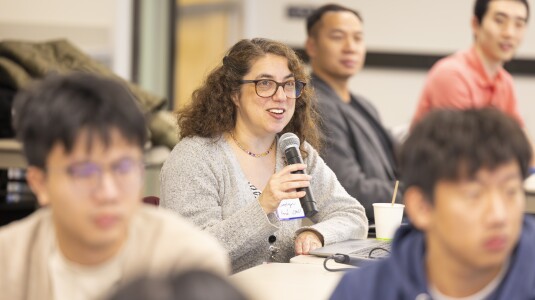
A global university competition to drive secure innovation in generative AI technology, which focuses on responsible AI and large language model coding security.

Credit: Wolfram Scheible
We partner with particular academic organizations across the world for deep and sustained collaborations in multiple research areas of mutual interest.
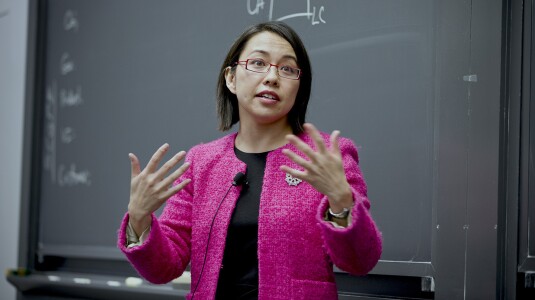
Courtesy of Pai-Ling Yin
We hire world-class academics to work on large-scale technical challenges, while they continue to teach and conduct research at their universities.

