How should a robot dig a single item out of a cluttered bin, feel when it has made contact, and adjust in real time without crushing what it touches? Single- and dual-arm contact-rich manipulation at production scale is still being solved. We are looking for a Principal Applied Scientist to define the control architectures that our next-generation grasping systems will be built on. The Manipulation Robotics team develops robotic workcells to pick, grasp, and move millions of items and packages across Amazon's fulfillment network. Reaching into clutter and grasping deformable and diverse items depends on solving contact: force-aware control, compliant behaviors, and the layering of classical controllers and learned policies. You will set the technical direction for how the team approaches contact-rich manipulation, working with leaders across the organization to establish this foundational capability. Key job responsibilities - Own the technical direction and contact-control strategy for contact-rich manipulation, including the boundary between low-level control and learned policy, balancing tradeoffs among speed, performance, quality, cost, complexity, and adaptability. - Identify the open scientific problems that gate contact-rich manipulation at production scale, and invent the methods that solve them. - Architect contact control built on force and tactile sensing, covering compliant-contact behaviors, hybrid position and force control, and the safe interaction envelope. Stay hands-on and personally write critical-path code. - Partner with scientists, hardware designers, and systems engineers to treat the platform, arm, and end-effector as one coherent hierarchical system, including co-designing compliant end-effectors as part of the control strategy. - Create mechanisms to learn from fielded production, reasoning rigorously about failure modes and improving recovery from unexpected contact. - Drive how simulation, analytical models, demonstrations, and real-robot data are used together to turn lab results into scaled warehouse performance. - Establish the reference implementations, evaluation standards, and design review practices that let others build on the architecture and scale your impact without your continuous involvement. - Develop other scientists and engineers through mentorship, technical review, and a leading role in hiring. A day in the life Amazon offers a full range of benefits that support you and eligible family members, including domestic partners. Benefits can vary by location, the number of regularly scheduled hours you work, length of employment, and job status such as seasonal or temporary employment. The benefits that generally apply to regular, full-time employees include: 1. Medical, Dental, and Vision Coverage 2. Maternity and Parental Leave Options 3. Paid Time Off (PTO) 4. 401(k) Plan If you are not sure that every qualification on the list above describes you exactly, we'd still love to hear from you! At Amazon, we value people with unique backgrounds, experiences, and skillsets. If you’re passionate about this role and want to make an impact on a global scale, please apply! About the team We are a small, high-ownership team building robotic workcells, from early-stage R&D through products fielded 24/7 in Amazon fulfillment centers. We work at the hard edge of grasping: contact-rich tasks, deformable and variable items, and mechanisms that must survive millions of cycles at fleet scale. Our people own problems end to end, and scientists work shoulder to shoulder with mechanical, electrical, software, and controls engineers in a fast-moving, highly empowered environment where research ideas turn into shipped systems.















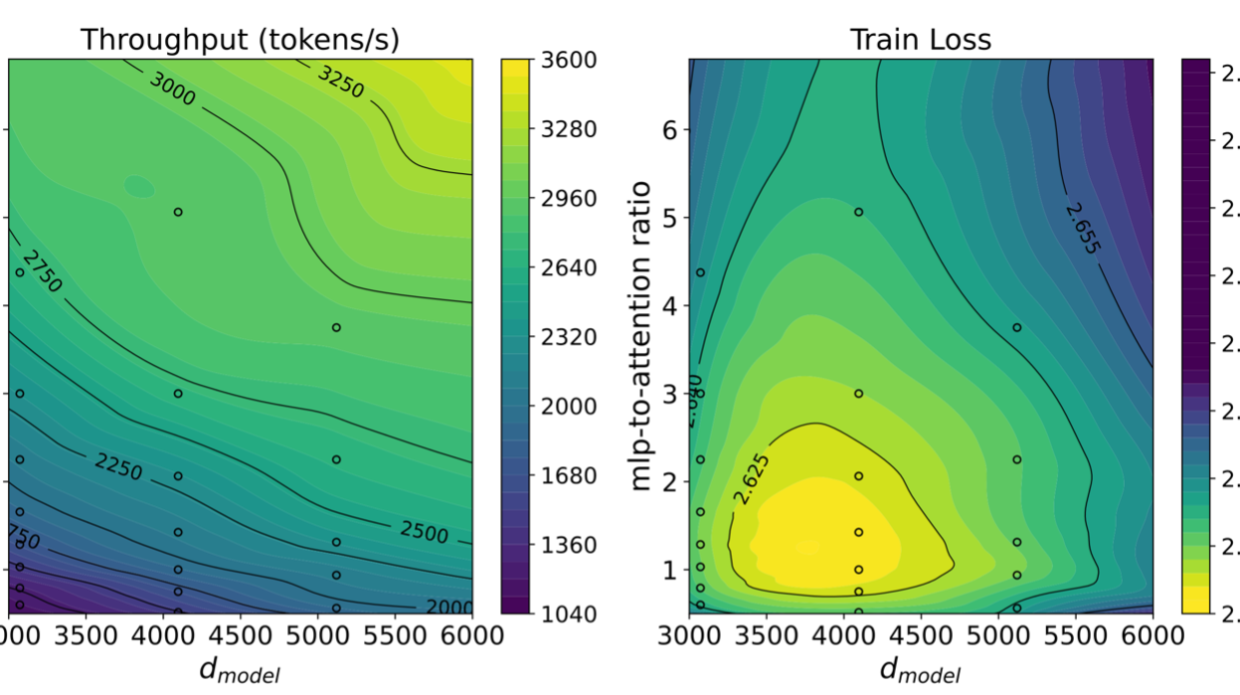
 May 15, 2026A new scaling law that relates particular architectural choices to loss helps identify models that improve throughput by up to 47% with no loss of accuracy.