














New audio-processing technology is making entertainment more accessible for millions of viewers.

Reasoning models can generate seven to 10 times as many tokens as necessary on simple tasks, creating unsustainable costs at scale. Amazon's vision for metacognitive AI could fundamentally shift how models allocate computational resources.

AGI SVP Rohit Prasad on how to mix your data with Amazon's training data at every stage — deep customization without catastrophic forgetting.

How agentic systems work under the hood — and how AWS’s new AgentCore framework implements their essential components.

Competitive-agent architecture develops security protections at machine speed, reducing weeks of work to hours.
Customer-obsessed science


Research areas


-
 December 5, 20256 min readA multiagent architecture separates data perception, tool knowledge, execution history, and code generation, enabling ML automation that works with messy, real-world inputs.
 -

-
-
November 20, 20254 min read
-


Featured news

Challenge pushes teams to demonstrate measurable gains in secure-coding performance while building AI agents that advance real-world utility and reliability at scale.

Meet the 63 Amazon Research Award (ARA) recipients, who represent 41 universities in 8 countries.
Initiative will fund over 100 doctoral students researching machine learning, computer vision, and natural-language processing at nine universities.

David Chang/Getty Images/iStockphoto
Led by David Luan and Pieter Abbeel, the lab will focus on developing new foundational capabilities for enabling useful AI agents.
-
NeurIPS 2024 Workshop on Fine-Tuning in Modern Machine Learning: Principles and Scalability2024Cybersecurity applications are challenged by constant distribution shifts due to the evolvement of services, users, and threats, degrading pretrained model performance. Fast adaptation is crucial for maintaining reliable security measures. Existing works primarily focus on pretraining models that can quickly adapt to new distributions, yet their fine-tuning relies on a rudimentary strategy that treats each
-
2024Classification with rejection emerges as a learning paradigm which allows models to abstain from making predictions. The predominant approach is to alter the supervised learning pipeline by augmenting typical loss functions, letting model rejection incur a lower loss than an incorrect prediction. Instead, we propose a different distributional perspective, where we seek to find an idealized data distribution
-
2023 Conference on Digital Experimentation @ MIT (CODE@MIT), NeurIPS 20242024This paper introduces the confounded pure exploration transductive linear bandit (CPET-LB) problem. As a motivating example, often online services cannot directly assign users to specific control or treatment experiences either for business or practical reasons. In these settings, naively comparing treatment and control groups that may result from self-selection can lead to biased estimates of underlying
-
2024Posterior sampling in contextual bandits with a Gaussian prior can be implemented exactly or approximately using the Laplace approximation. The Gaussian prior is computationally efficient but it cannot describe complex distributions. In this work, we propose approximate posterior sampling algorithms for contextual bandits with a diffusion model prior. The key idea is to sample from a chain of approximate
-
2024In the domain of code generation, self-debugging is crucial. It allows LLMs to refine their generated code based on execution feedback. This is particularly important because generating correct solutions in one attempt proves challenging for complex tasks. Prior works on self-debugging mostly focus on prompting methods by providing LLMs with few-shot examples, which work poorly on small open-sourced LLMs
Collaborations
View allWhether you're a faculty member or student, there are number of ways you can engage with Amazon.
View all

Gretchen Ertl
The program offers unrestricted funds and other resources to support research at academic institutions and non-profit organizations in areas that align with our mission.
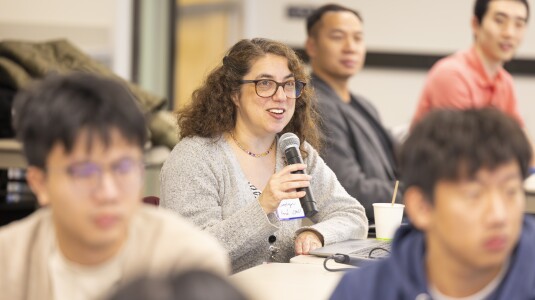
A global university competition to drive secure innovation in generative AI technology, which focuses on responsible AI and large language model coding security.

Credit: Wolfram Scheible
We partner with particular academic organizations across the world for deep and sustained collaborations in multiple research areas of mutual interest.

Courtesy of Pai-Ling Yin
We hire world-class academics to work on large-scale technical challenges, while they continue to teach and conduct research at their universities.

