Runtime optimizations and a thorough evaluation process driven by agentic AI help ensure that models written in PyTorch will execute efficiently and reliably on Trainium systems.

Expanding the mix of synthetic data used to train a tabular foundation model enables it to adapt to new tables without new models and lead the single-model field on the TabArena benchmark.

Using the Neuron Kernel Interface, a Reactor–AWS collaboration tackled the dynamic shapes, memory access patterns, and cache management that make real-time autoregressive diffusion hard—building techniques that generalize across models.


Three new papers from Amazon Bio Discovery address bottlenecks in AI-driven antibody engineering, from benchmarking binding predictors to experimentally validating de novo design.
New research indicates that AI agents learn compressible models of data, which don’t have enough space to enable memorization.
Customer-obsessed science

Research areas


-
 November 11, 20265 min readStatic analysis of deployed networks helps reduce the risk that sensitive data leaks across partitions, supporting the security and reliability of global-scale networking.
-

-
-
-
October 20, 20263 min read


Featured news

The collaboration aims to advance research while broadening participation and translating discovery into real-world solutions.

Submissions open October 1 and close on November 11, 2026

The collaboration will support research in robotics, industrial and systems engineering, and aerospace technology while fostering innovation in foundational and emerging technologies.

The Build on Trainium program is a $110 million credit initiative supporting AI research at 30 universities including Stanford, UC Berkeley, UIUC, UCLA, CMU, and MIT, with a focus on Responsible AI.

The Antibody Developability Benchmark is powered by one of the most diverse antibody datasets in public literature, enabling transparent performance evaluation for AI-guided antibody design.

Challenge pushes teams to demonstrate measurable gains in secure-coding performance while building AI agents that advance real-world utility and reliability at scale.

Initiative will fund over 100 doctoral students researching machine learning, computer vision, and natural-language processing at nine universities.
-
ICML 20192019Producing probabilistic forecasts for large collections of similar and/or dependent time series is a practically relevant and challenging task. Classical time series models fail to capture complex patterns in the data, and multivariate techniques struggle to scale to large problem sizes. Their reliance on strong structural assumptions makes them data-efficient, and allows them to provide uncertainty estimates
-
ACL 20192019Automatic summarization is typically treated as a 1-to-1 mapping from document to summary. Documents such as news articles, however, are structured and often cover multiple topics or aspects; and readers may be interested in only some of them. We tackle the task of aspect-based summarization, where, given a document and a target aspect, our models generate a summary centered around the aspect. We induce
-
ICASSP 20192019We propose a novel audio watermarking system that is robust to the distortion due to the indoor acoustic propagation channel between the loudspeaker and the receiving microphone. The system utilizes a set of new algorithms that effectively mitigate the impact of room reverberation and interfering sound sources without using dereverberation procedures. The decoder has low-latency and it operates asynchronously
-
PAL 20192019Active learning holds promise of significantly reducing data annotation costs while maintaining reasonable model performance. However, it requires sending data to annotators for labeling. This presents a possible privacy leak when the training set includes sensitive user data. In this paper, we describe an approach for carrying out privacy preserving active learning with quantifiable guarantees. We evaluate
-
AISTATS 20202019We study the problem of subsampling in differential privacy (DP), a question that is the centerpiece behind many successful differentially private machine learning algorithms. Specifically, we provide a tight upper bound on the Rényi Differential Privacy (RDP) (Mironov, 2017) parameters for algorithms that: (1) subsample the dataset, and then (2) applies a randomized mechanism M to the subsample, in terms
Collaborations
View allWhether you're a faculty member or student, there are number of ways you can engage with Amazon.
View all

Gretchen Ertl
The program offers unrestricted funds and other resources to support research at academic institutions and non-profit organizations in areas that align with our mission.
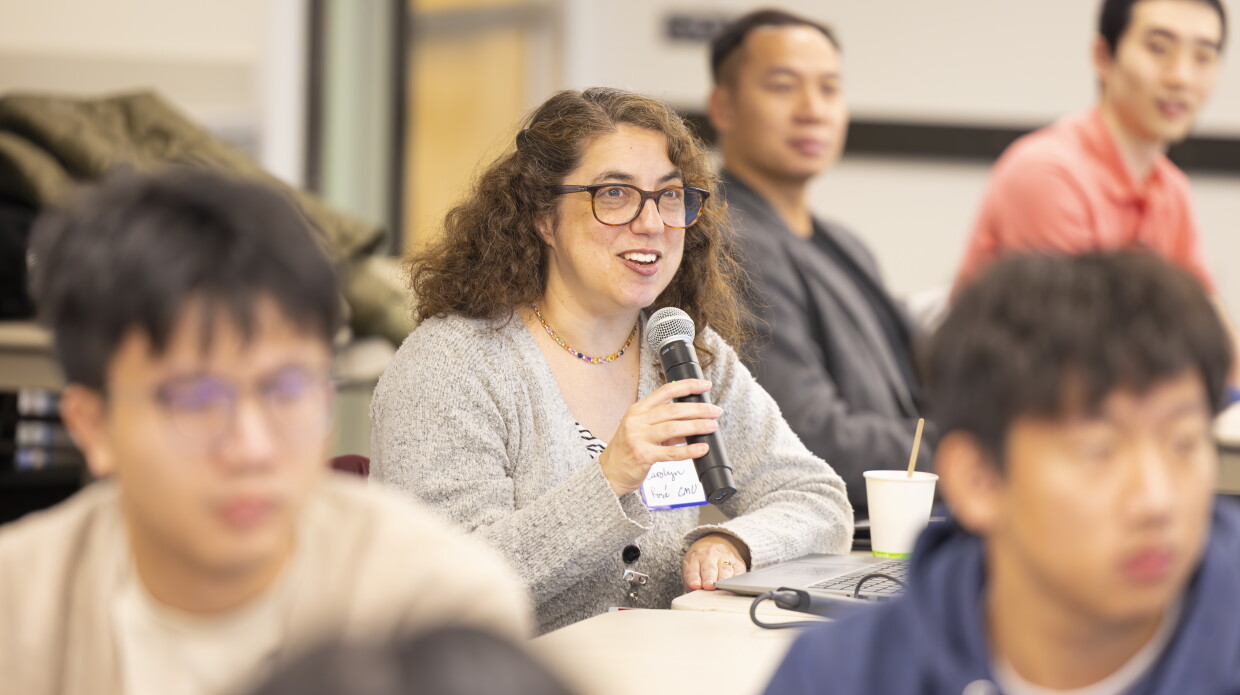
A global university competition to drive secure innovation in generative AI technology, which focuses on responsible AI and large language model coding security.

Credit: Wolfram Scheible
We partner with particular academic organizations across the world for deep and sustained collaborations in multiple research areas of mutual interest.
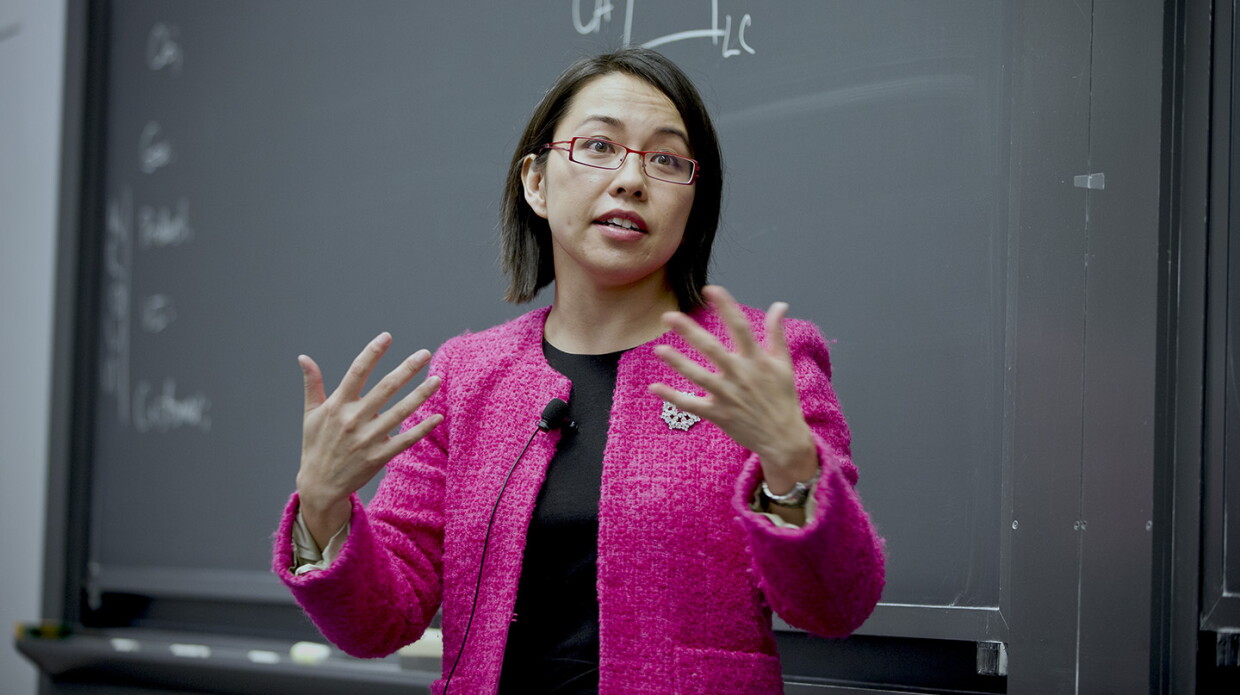
Courtesy of Pai-Ling Yin
We hire world-class academics to work on large-scale technical challenges, while they continue to teach and conduct research at their universities.