














AGI SVP Rohit Prasad on how to mix your data with Amazon's training data at every stage — deep customization without catastrophic forgetting.

Reasoning models can generate seven to 10 times as many tokens as necessary on simple tasks, creating unsustainable costs at scale. Amazon's vision for metacognitive AI could fundamentally shift how models allocate computational resources.

How agentic systems work under the hood — and how AWS’s new AgentCore framework implements their essential components.

Competitive-agent architecture develops security protections at machine speed, reducing weeks of work to hours.
Customer-obsessed science


Research areas


-
 December 5, 20256 min readA multiagent architecture separates data perception, tool knowledge, execution history, and code generation, enabling ML automation that works with messy, real-world inputs.
 -

-
-
November 20, 20254 min read
-


Featured news

Challenge pushes teams to demonstrate measurable gains in secure-coding performance while building AI agents that advance real-world utility and reliability at scale.

Meet the 63 Amazon Research Award (ARA) recipients, who represent 41 universities in 8 countries.
Initiative will fund over 100 doctoral students researching machine learning, computer vision, and natural-language processing at nine universities.

David Chang/Getty Images/iStockphoto
Led by David Luan and Pieter Abbeel, the lab will focus on developing new foundational capabilities for enabling useful AI agents.
-
CVPR 20212021We consider the task of 3D pose estimation and tracking of multiple people seen in an arbitrary number of camera feeds. We propose TesseTrack1, a novel top-down approach that simultaneously reasons about multiple individuals’ 3D body joint reconstructions and associations in space and time in a single end-to-end learnable framework. At the core of our approach is a novel spatio-temporal formulation that
-
ICNLP 20212021Fine-tuning self-supervised pre-trained language models such as BERT has significantly improved state-of-the-art performance on natural language processing tasks. Similar finetuning setups can also be used in commercial large scale Spoken Language Understanding (SLU) systems to perform intent classification and slot tagging on user queries. Finetuning such powerful models for use in commercial systems requires
-
Journal of Causal Inference2021The Principle of Insufficient Reason (PIR) assigns equal probabilities to each alternative of a random experiment whenever there is no reason to prefer one over the other. The Maximum Entropy Principle (MaxEnt) generalizes PIR to the case where statistical information like expectations are given. It is known that both principles result in paradoxical probability updates for joint distributions of cause
-
NeurIPS 2021 Workshop on CtrlGen2021Learning-based methods for training embodied agents typically require a large number of high-quality scenes that contain realistic layouts and support meaningful interactions. However, current simulators for Embodied AI (EAI) challenges only provide simulated indoor scenes with a limited number of layouts. This paper presents LUMINOUS, the first research framework that employs stateof-the-art indoor scene
-
PRX Quantum2021As quantum computers approach the fault tolerance threshold, diagnosing and characterizing the noise on large scale quantum devices is increasingly important. One of the most important classes of noise channels is the class of Pauli channels, for reasons of both theoretical tractability and experimental relevance. Here we present a practical algorithm for estimating the s nonzero Pauli error rates in an
Collaborations
View allWhether you're a faculty member or student, there are number of ways you can engage with Amazon.
View all

Gretchen Ertl
The program offers unrestricted funds and other resources to support research at academic institutions and non-profit organizations in areas that align with our mission.
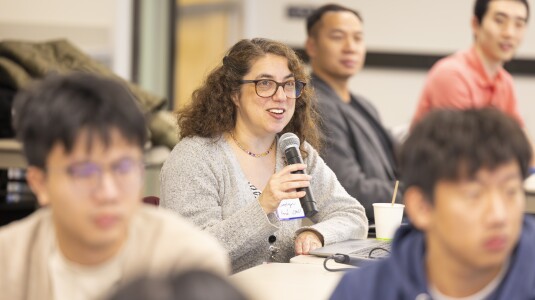
A global university competition to drive secure innovation in generative AI technology, which focuses on responsible AI and large language model coding security.

Credit: Wolfram Scheible
We partner with particular academic organizations across the world for deep and sustained collaborations in multiple research areas of mutual interest.
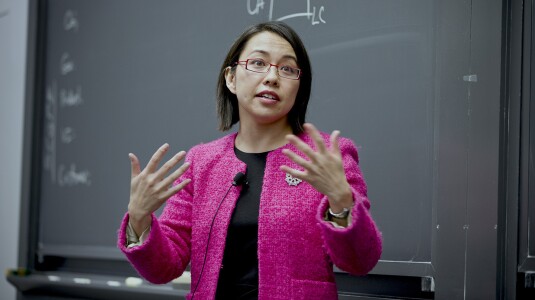
Courtesy of Pai-Ling Yin
We hire world-class academics to work on large-scale technical challenges, while they continue to teach and conduct research at their universities.

