














A family of four foundation models designed to meet diverse enterprise needs across reasoning, multimodal processing, and real-time conversational AI.

How agentic systems work under the hood — and how AWS’s new AgentCore framework implements their essential components.

Reasoning models can generate seven to 10 times as many tokens as necessary on simple tasks, creating unsustainable costs at scale. Amazon's vision for metacognitive AI could fundamentally shift how models allocate computational resources.

Amazon's competitive-agent architecture creates a continuous improvement cycle that develops security protections at machine speed, reducing what typically takes weeks down to hours.


A new approach to reducing carbon emissions reveals previously hidden emission “hotspots” within value chains, helping organizations make more detailed and dynamic decisions about their future carbon footprints.
Customer-obsessed science


Research areas


-
 December 5, 20256 min readA multiagent architecture separates data perception, tool knowledge, execution history, and code generation, enabling ML automation that works with messy, real-world inputs.
 -

-
-
November 20, 20254 min read
-
October 20, 20254 min read


Featured news
Initiative will fund over 100 doctoral students researching machine learning, computer vision, and natural-language processing at nine universities.
The collaboration will advance research in generative AI, robotics, natural language processing and cloud computing while fostering innovation in foundational and emerging technologies.
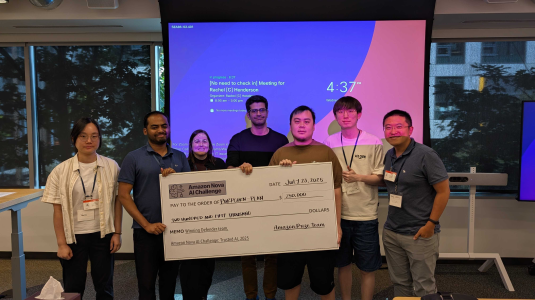
University teams battle to harden and hack AI coding assistants in head-to-head tournament

David Chang/Getty Images/iStockphoto
Led by David Luan and Pieter Abbeel, the lab will focus on developing new foundational capabilities for enabling useful AI agents.

The company's new state-of-the-art foundation models deliver frontier intelligence and industry-leading price performance.
-
Interspeech 20212021As more speech processing applications execute locally on edge devices, a set of resource constraints must be considered. In this work we address one of these constraints, namely overthe-network data budgets for transferring models from server to device. We present neural update approaches for release of subsequent speech model generations abiding by a data budget. We detail two architecture-agnostic methods
-
ACL-IJCNLP 2021 Workshop on e-Commerce and NLP (ECNLP)2021The growing popularity of Virtual Assistants poses new challenges for Entity Resolution, the task of linking mentions in text to their referent entities in a knowledge base. Specifically, in the shopping domain, customers tend to mention the entities implicitly (e.g., “organic milk”) rather than use the entity names explicitly, leading to a large number of candidate products. Meanwhile, for the same query
-
SIGDIAL 2021 SummDial Workshop2021Automatic summarization aims to extract important information from large amounts of textual data in order to create a shorter version of the original texts while preserving its information. Training traditional extractive summarization models relies heavily on humanengineered labels such as sentence-level annotations of summary-worthiness. However, in many use cases, such human-engineered labels do not
-
TSD 20212021In this paper, we explore the benefits of incorporating context into a Recurrent Neural Network (RNN-T) based Automatic Speech Recognition (ASR) model to improve the speech recognition for virtual assistants. Specifically, we use meta information extracted from the time at which the utterance is spoken and the approximate location information to make ASR context aware. We show that these contextual information
-
KDD 20212021We propose a modular BiLSTM/ CNN /Transformer deep-learning encoder architecture, together with a data synthesis and training approach, to solve the problem of matching catalog products across different languages, different local catalogs, and different catalog data contributors. The end-to-end model relies solely on raw natural language textual data in the catalog entries and on images of the products,
Collaborations
View allWhether you're a faculty member or student, there are number of ways you can engage with Amazon.
View all

Gretchen Ertl
The program offers unrestricted funds and other resources to support research at academic institutions and non-profit organizations in areas that align with our mission.
A global university competition to drive secure innovation in generative AI technology, which focuses on responsible AI and large language model coding security.

Credit: Wolfram Scheible
We partner with particular academic organizations across the world for deep and sustained collaborations in multiple research areas of mutual interest.
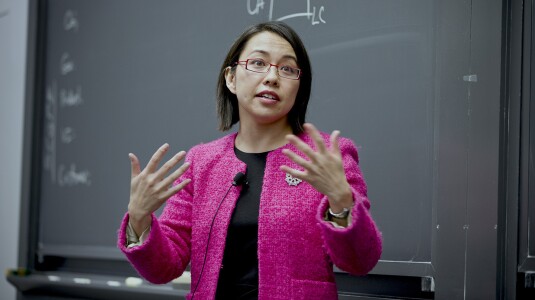
Courtesy of Pai-Ling Yin
We hire world-class academics to work on large-scale technical challenges, while they continue to teach and conduct research at their universities.

