Runtime optimizations and a thorough evaluation process driven by agentic AI help ensure that models written in PyTorch will execute efficiently and reliably on Trainium systems.

Expanding the mix of synthetic data used to train a tabular foundation model enables it to adapt to new tables without new models and lead the single-model field on the TabArena benchmark.

Using the Neuron Kernel Interface, a Reactor–AWS collaboration tackled the dynamic shapes, memory access patterns, and cache management that make real-time autoregressive diffusion hard—building techniques that generalize across models.


Three new papers from Amazon Bio Discovery address bottlenecks in AI-driven antibody engineering, from benchmarking binding predictors to experimentally validating de novo design.
New research indicates that AI agents learn compressible models of data, which don’t have enough space to enable memorization.
Customer-obsessed science

Research areas


-
 November 16, 202611 min readNew open-source tool turns existing test suites into sets of formal-verification tasks, which catch buggy solutions that tests alone would miss.
-
 November 11, 20265 min read
-
-
-


Featured news

The collaboration aims to advance research while broadening participation and translating discovery into real-world solutions.

Submissions open October 1 and close on November 11, 2026

The collaboration will support research in robotics, industrial and systems engineering, and aerospace technology while fostering innovation in foundational and emerging technologies.

The Build on Trainium program is a $110 million credit initiative supporting AI research at 30 universities including Stanford, UC Berkeley, UIUC, UCLA, CMU, and MIT, with a focus on Responsible AI.

The Antibody Developability Benchmark is powered by one of the most diverse antibody datasets in public literature, enabling transparent performance evaluation for AI-guided antibody design.

Challenge pushes teams to demonstrate measurable gains in secure-coding performance while building AI agents that advance real-world utility and reliability at scale.

Initiative will fund over 100 doctoral students researching machine learning, computer vision, and natural-language processing at nine universities.
-
ICLR 20232023Like many other machine learning applications, neural machine translation (NMT) benefits from over-parameterized deep neural models. However, these models have been observed to be brittle: NMT model predictions are sensitive to small input changes and can show significant variation across re-training or incremental model updates. This work studies a frequently used method in NMT, pseudo-label training (
-
CVPR 20232023In this work, instead of directly predicting the pixel-level segmentation masks, the problem of referring image segmentation is formulated as sequential polygon generation, and the predicted polygons can be later converted into segmentation masks. This is enabled by a new sequence-to-sequence framework, Polygon Transformer (PolyFormer), which takes a sequence of image patches and text query tokens as input
-
PAKDD 20232023Dense embedding-based semantic matching is widely used in e-commerce product search to address the shortcomings of lexical matching such as sensitivity to spelling variants. The recent advances in BERT-like language model encoders, have however, not found their way to realtime search due to the strict inference latency requirement imposed on e-commerce websites. While bi-encoder BERT architectures enable
-
AAAI 2023 Workshop on Knowledge Augmented Methods for NLP2023The abundance of benchmark datasets supports the recent trend of increased attention given to Question Answering (QA) tasks. However, most of them lack a diverse selection of QA types and more challenging questions. In this work, we present StoryQA, a new task and dataset addressing diverse QA problems for both in-context and out-of-context questions. Additionally, we developed QA models based on large
-
PPoPP 20232023Jointly utilizing multiple GPUs to train graph neural networks (GNNs) is crucial for handling large graphs and achieving high efficiency. However, we find that existing systems suffer from high communication costs and low GPU utilization due to improper data layout and training procedures. Thus, we propose a system dubbed Distributed Sampling and Pipelining (DSP) for multi-GPU GNN training. DSP adopts a
Collaborations
View allWhether you're a faculty member or student, there are number of ways you can engage with Amazon.
View all

Gretchen Ertl
The program offers unrestricted funds and other resources to support research at academic institutions and non-profit organizations in areas that align with our mission.
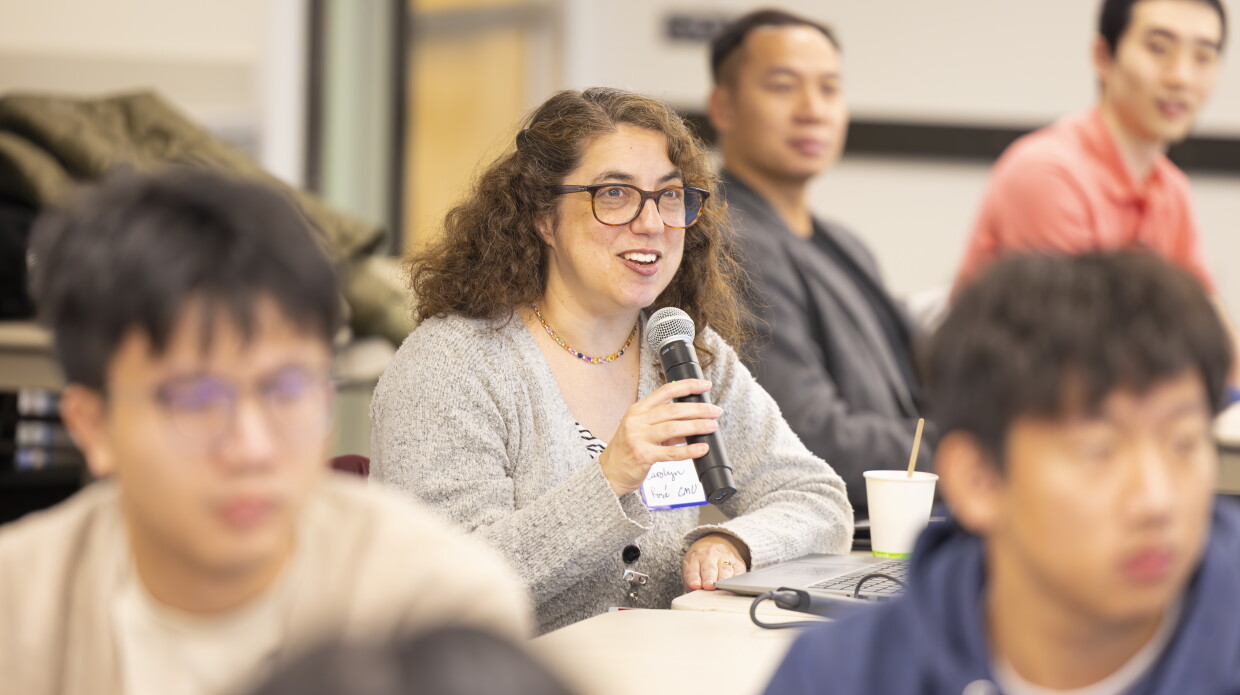
A global university competition to drive secure innovation in generative AI technology, which focuses on responsible AI and large language model coding security.

Credit: Wolfram Scheible
We partner with particular academic organizations across the world for deep and sustained collaborations in multiple research areas of mutual interest.
Courtesy of Pai-Ling Yin
We hire world-class academics to work on large-scale technical challenges, while they continue to teach and conduct research at their universities.