














New audio-processing technology is making entertainment more accessible for millions of viewers.

Reasoning models can generate seven to 10 times as many tokens as necessary on simple tasks, creating unsustainable costs at scale. Amazon's vision for metacognitive AI could fundamentally shift how models allocate computational resources.

AGI SVP Rohit Prasad on how to mix your data with Amazon's training data at every stage — deep customization without catastrophic forgetting.

How agentic systems work under the hood — and how AWS’s new AgentCore framework implements their essential components.

Competitive-agent architecture develops security protections at machine speed, reducing weeks of work to hours.
Customer-obsessed science


Research areas


-
 December 5, 20256 min readA multiagent architecture separates data perception, tool knowledge, execution history, and code generation, enabling ML automation that works with messy, real-world inputs.
 -

-
-
November 20, 20254 min read
-


Featured news

Challenge pushes teams to demonstrate measurable gains in secure-coding performance while building AI agents that advance real-world utility and reliability at scale.

Meet the 63 Amazon Research Award (ARA) recipients, who represent 41 universities in 8 countries.
Initiative will fund over 100 doctoral students researching machine learning, computer vision, and natural-language processing at nine universities.

David Chang/Getty Images/iStockphoto
Led by David Luan and Pieter Abbeel, the lab will focus on developing new foundational capabilities for enabling useful AI agents.
-
2025Providing Language Models (LMs) with relevant evidence in the context (either via retrieval or user-provided) can significantly improve their ability to provide better-grounded responses. However, recent studies have found that LMs often struggle to fully comprehend and utilize key evidence from the context, especially when it contains noise and irrelevant information—an issue common in real-world scenarios
-
2025Speech foundation models achieve strong generalization across languages and acoustic conditions, but require significant computational resources for inference. In the context of speech foundation models, pruning techniques have been studied that dynamically optimize model structures based on the target audio leveraging external context. In this work, we extend this line of research and propose context-driven
-
AISTATS 2025, ACL 2024 Workshop on Privacy in Natural Language Processing2025Large Language Models (LLMs) have seen widespread adoption due to their remarkable natural language capabilities. However, when deploying them in real-world settings, it is important to align LLMs to generate texts according to acceptable human standards. Methods such as Proximal Policy Optimization (PPO) and Direct Preference Optimization (DPO) have enabled significant progress in refining LLMs using human
-
2025As large language models (LLMs) become increasingly versatile, numerous large scale benchmarks have been developed to thoroughly assess their capabilities. These benchmarks typically consist of diverse datasets and prompts to evaluate different aspects of LLM performance. However, comprehensive evaluations on hundreds or thousands of prompts incur tremendous costs in terms of computation, money, and time
-
2025In this paper, we study the problem of estimation and learning under temporal distribution shift. Consider an observation sequence of length n, which is a noisy realization of a time-varying ground-truth sequence. Our focus is to develop methods to estimate the ground-truth at the final time-step while providing sharp point-wise estimation error rates. We show that, without prior knowledge on the level
Collaborations
View allWhether you're a faculty member or student, there are number of ways you can engage with Amazon.
View all

Gretchen Ertl
The program offers unrestricted funds and other resources to support research at academic institutions and non-profit organizations in areas that align with our mission.
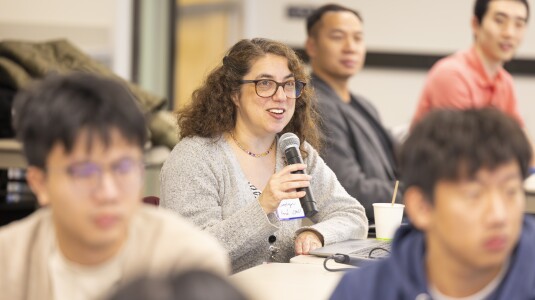
A global university competition to drive secure innovation in generative AI technology, which focuses on responsible AI and large language model coding security.

Credit: Wolfram Scheible
We partner with particular academic organizations across the world for deep and sustained collaborations in multiple research areas of mutual interest.
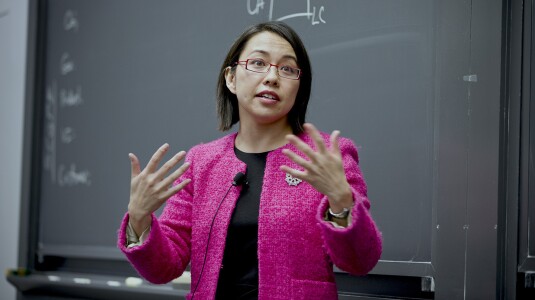
Courtesy of Pai-Ling Yin
We hire world-class academics to work on large-scale technical challenges, while they continue to teach and conduct research at their universities.

