













Using the Neuron Kernel Interface, a Reactor–AWS collaboration tackled the dynamic shapes, memory access patterns, and cache management that make real-time autoregressive diffusion hard—building techniques that generalize across models.


Three new papers from Amazon Bio Discovery address bottlenecks in AI-driven antibody engineering, from benchmarking binding predictors to experimentally validating de novo design.
New research indicates that AI agents learn compressible models of data, which don’t have enough space to enable memorization.

How the Verus "program verifier", which automatically checks code against a mathematical specification of its functionality, helps increase security assurance in software projects.

Ten years after we founded the Automated Reasoning Group, mathematical logic has moved from academic research into production services that secure millions of customer workloads — demonstrating that systems can be provably correct, not just probably correct.
Customer-obsessed science

Research areas











-
 October 12, 202614 min read“Priming” reuses pretrained Transformer weights to build models with more efficient architectures at less than 1% of the original training cost and with throughputs up to twice as high.
 -

-
-
August 21, 20269 min read
-
July 30, 20268 min read


Featured news

The collaboration will support research in robotics, industrial and systems engineering, and aerospace technology while fostering innovation in foundational and emerging technologies.

Submissions open October 1 and close on November 4, 2026

The Build on Trainium program is a $110 million credit initiative supporting AI research at 30 universities including Stanford, UC Berkeley, UIUC, UCLA, CMU, and MIT, with a focus on Responsible AI.

The Antibody Developability Benchmark is powered by one of the most diverse antibody datasets in public literature, enabling transparent performance evaluation for AI-guided antibody design.

Challenge pushes teams to demonstrate measurable gains in secure-coding performance while building AI agents that advance real-world utility and reliability at scale.

Initiative will fund over 100 doctoral students researching machine learning, computer vision, and natural-language processing at nine universities.
-
AAAI 20182018The Alexa Meaning Representation Language (AMRL) is a compositional graph-based semantic representation that includes fine-grained types, properties, actions, and roles and can represent a wide variety of spoken language. AMRL increases the ability of virtual assistants to represent more complex requests, including logical and conditional statements as well as ones with nested clauses. Due to this representational
-
ICLR 20182018We present a personalized recommender system using neural network for recommending products, such as eBooks, audio-books, Mobile Apps, Video and Music. It produces recommendations based on customer’s implicit feedback history such as purchases, listens or watches. Our key contribution is to formulate recommendation problem as a model that encodes historical behavior to predict the future behavior using
-
ICML 20182018This work explores the idea of a causal contextual multi-armed bandit approach to automated marketing, where we estimate and optimize the causal (incremental) effects. Focusing on causal effect leads to better return on investment (ROI) by targeting only the persuadable customers who wouldn’t have taken the action organically. Our approach draws on strengths of causal inference, uplift modeling, and multi-armed
-
WWW 20182018Structured prediction, where outcomes have a precedence order, lies at the heart of machine learning for information retrieval, movie recommendation, product review prediction, and digital advertising. Ordinal ranking, in particular, assumes that the structured response has a linear ranked order. Due to the extensive applicability of these models, substantial research has been devoted to understanding them
-
ICML 20182018The Gaussian mechanism is an essential building block used in multitude of differentially private data analysis algorithms. In this paper we revisit the Gaussian mechanism and show that the original analysis has several important limitations. Our analysis reveals that the variance formula for the original mechanism is far from tight in the high privacy regime (ε → 0) and it cannot be extended to the low
Collaborations
View allWhether you're a faculty member or student, there are number of ways you can engage with Amazon.
View all

Gretchen Ertl
The program offers unrestricted funds and other resources to support research at academic institutions and non-profit organizations in areas that align with our mission.
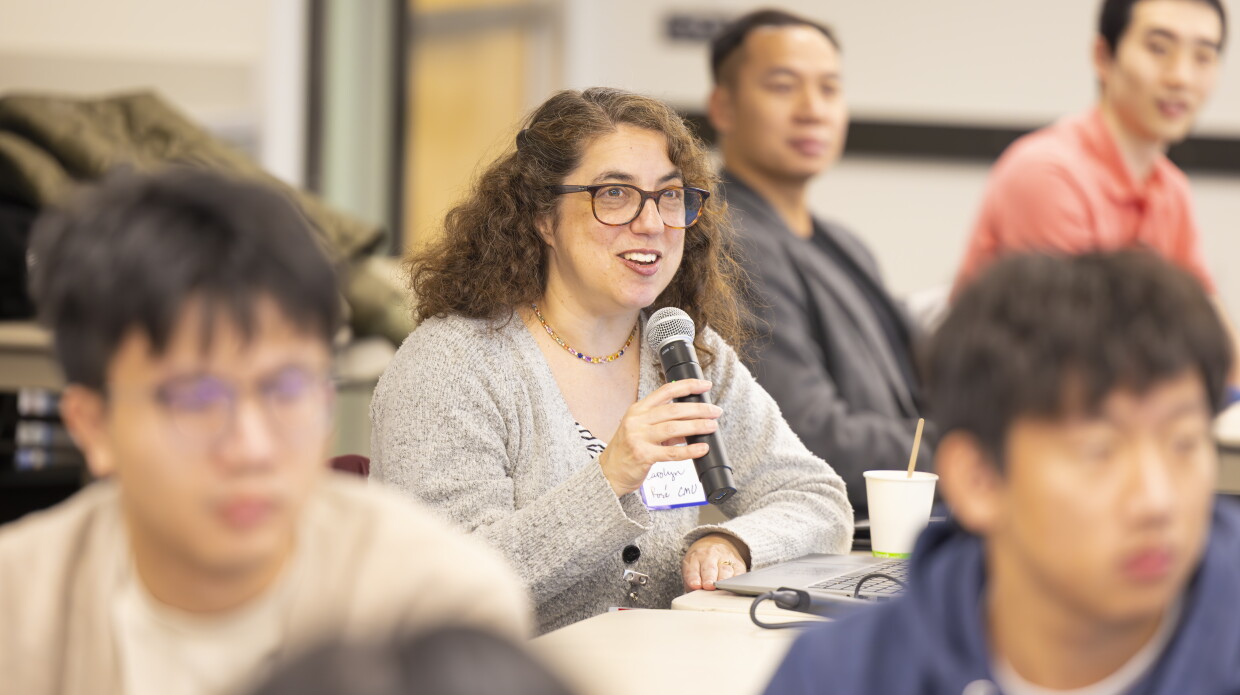
A global university competition to drive secure innovation in generative AI technology, which focuses on responsible AI and large language model coding security.

Credit: Wolfram Scheible
We partner with particular academic organizations across the world for deep and sustained collaborations in multiple research areas of mutual interest.
Courtesy of Pai-Ling Yin
We hire world-class academics to work on large-scale technical challenges, while they continue to teach and conduct research at their universities.