Scenario Diffusion helps Zoox vehicles navigate safety-critical situations

Generative AI supports the creation, at scale, of complex, realistic driving scenarios that can be directed to specific locations and environments.

Autonomous vehicles (AVs) such as the Zoox purpose-built robotaxi represent a new era in human mobility, but the deployment of AVs comes with many challenges. It’s essential to do extensive safety testing using simulation, which requires the creation of synthetic driving scenarios at scale. Particularly important is generating realistic safety-critical road scenarios, to test how AVs will react to a wide range of driving situations, including those that are relatively rare and potentially dangerous.
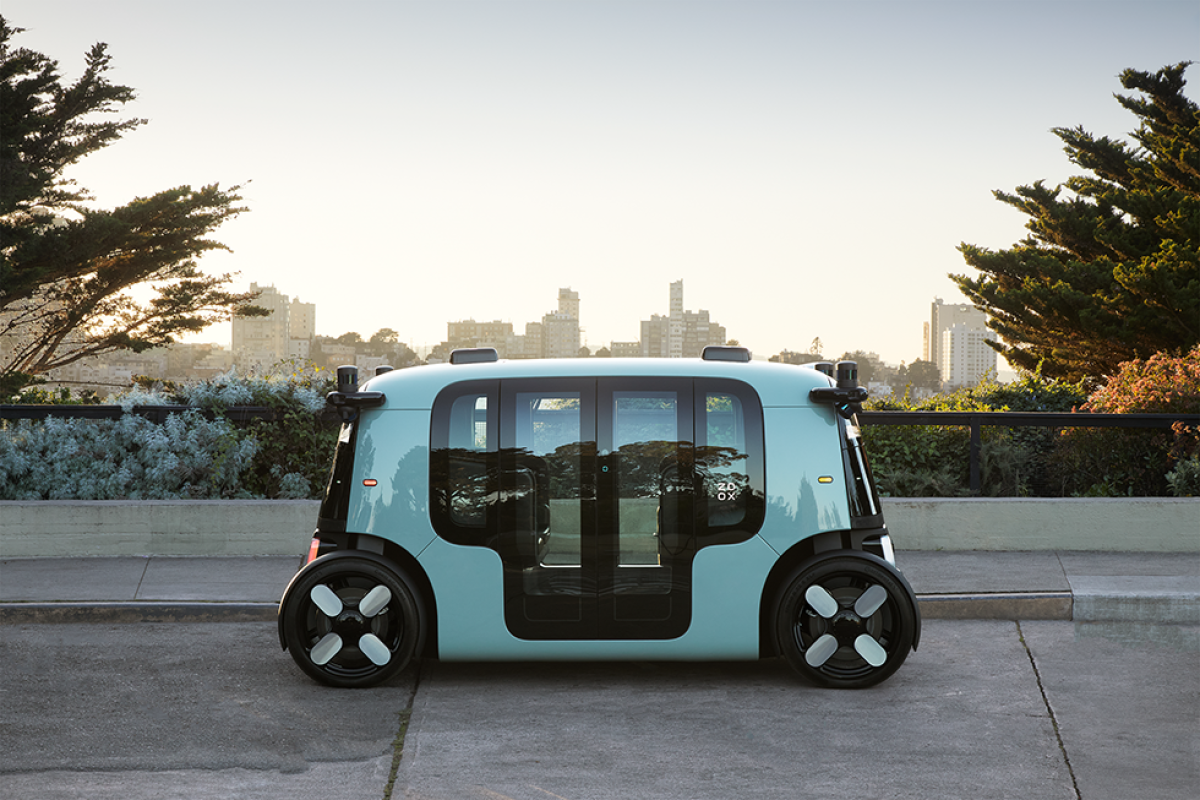
Zoox robotaxi.png
The Zoox robotaxi.

Traditional methods tend to produce scenarios of limited complexity and struggle to replicate many real-world situations. More recently, machine learning (ML) models have used deep learning to produce complex traffic scenarios based on specified map regions, but they offer limited means of shaping the resulting scenarios in terms of vehicle positionings, speeds, and trajectories. This makes it difficult to create specific safety-critical scenarios at scale. Designing huge numbers of such scenarios by hand, meanwhile, is impractical.
Related content
Leveraging a large vision-language foundation model enables state-of-the-art performance in remote-object grounding.

In a paper we presented at the 2023 Conference on Neural Information Processing Systems (NeurIPS), we address these challenges with a method we call Scenario Diffusion. Our system comprises a novel ML architecture based on latent diffusion, an ML technique used in image generation in which a model learns to convert random noise into detailed images.

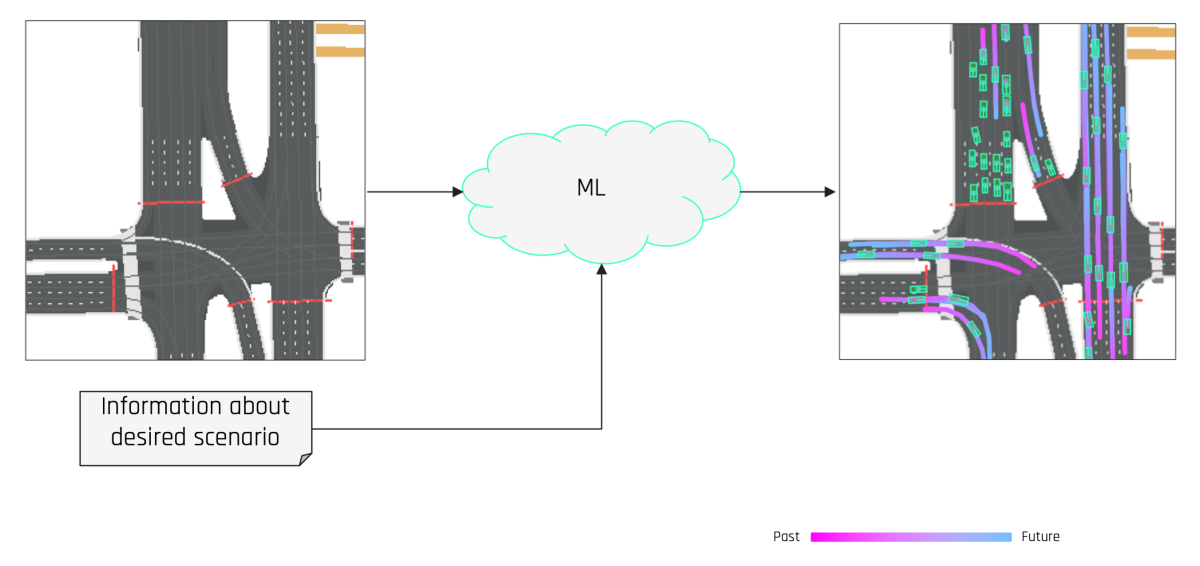
Scenario Diffusion is able to output highly controllable and realistic traffic scenarios, at scale. It is controllable because the outputs of the Scenario Diffusion model are based not only on the map of the desired area but also on sets of easily produced descriptors that can specify the positioning and characteristics of some or all of the vehicles in a scene. These descriptors, which we call agent tokens, take the form of feature vectors. We can similarly specify global scene tokens, which indicate how busy the roads in a given scenario should be.
Directed scenario generation.png
Providing the Scenario Diffusion model with additional information about the desired scenario directs the generative process.

Combining a diffusion architecture with these token-based controls allows us to produce safety-critical driving scenarios at will, boosting our ability to validate the safety of our purpose-built robotaxi. We are excited to apply generative AI where it can have a big impact on the established practical challenge of AV safety.

Inside the Scenario Diffusion model

AV control software is typically divided into perception, prediction, and motion-planning modules. On the road, an AV’s cameras and other sensors perceive the road situation, which can be represented, for motion-planning purposes, as a simplified bird’s-eye-view image.

Related content
Company is testing a new class of robots that use artificial intelligence and computer vision to move freely throughout facilities.

Each of the vehicles (“agents”) in this multi-channelled image, including the AV itself, is represented as a “bounding box” that reflects the vehicle’s width, length, and position on the local map. The image also contains information on other characteristics of the vehicles, such as heading and trajectory. These characteristics and the map itself are the two key elements of a synthetic driving scenario that are required to validate motion planning in simulation.

The Scenario Diffusion model has two components. The first is an autoencoder, which projects complex driving scenarios into a more manageable representational space. The second component, the diffusion model, operates in this space.

Like all diffusion models, ours is trained by adding noise to real-world scenarios and asking the model to remove this noise. Once the model is trained, we can sample random noise and use the model to gradually convert this noise into a realistic driving scenario. For a detailed exploration of our training and inference processes and model architecture, dive into our paper.

We trained the model on both public and proprietary real-world datasets of driving logs containing millions of driving scenarios across a variety of geographical regions and settings.

Prior ML methods for generating driving scenarios typically place the bounding boxes of agents on a map — essentially a static snapshot, with no motion information. They then use object recognition to identify those boxes before applying heuristics or learned methods to decide on suitable trajectories for each agent. Such hybrid solutions can struggle to capture the nuances of real-world driving.

Related content
A combination of cutting-edge hardware, sensor technology, and bespoke machine learning approaches can predict trajectories of vehicles, people, and even animals, as far as 8 seconds into the future.

A key contribution of our work is that it achieves the simultaneous inference of agent placement and behavior. When our trained model generates a traffic scenario for a given map, every agent it positions in the scene has an associated feature vector that describes its characteristics, such as the dimensions, orientation, and trajectory of the vehicle. The driving scenario emerges fully formed.

Our feature vector approach not only provides more-realistic scenarios but also makes it very easy to add information to the model, making it highly adaptable. In the paper, we deal only with standard vehicles, but it would be straightforward to generate more-complex scenarios that include bikes, pedestrians, scooters, animals — anything previously encountered by a Zoox robotaxi in the real world.

Creating safety-critical “edge cases” on demand

If we simply want to create many thousands of realistic driving scenarios, with no particular situation in mind, we let Scenario Diffusion freely generate traffic on a particular map. This type of approach has been explored in prior research. But randomly generated scenarios are not an efficient way to validate how AV software deals with rare, safety-critical events.

Initial map.png
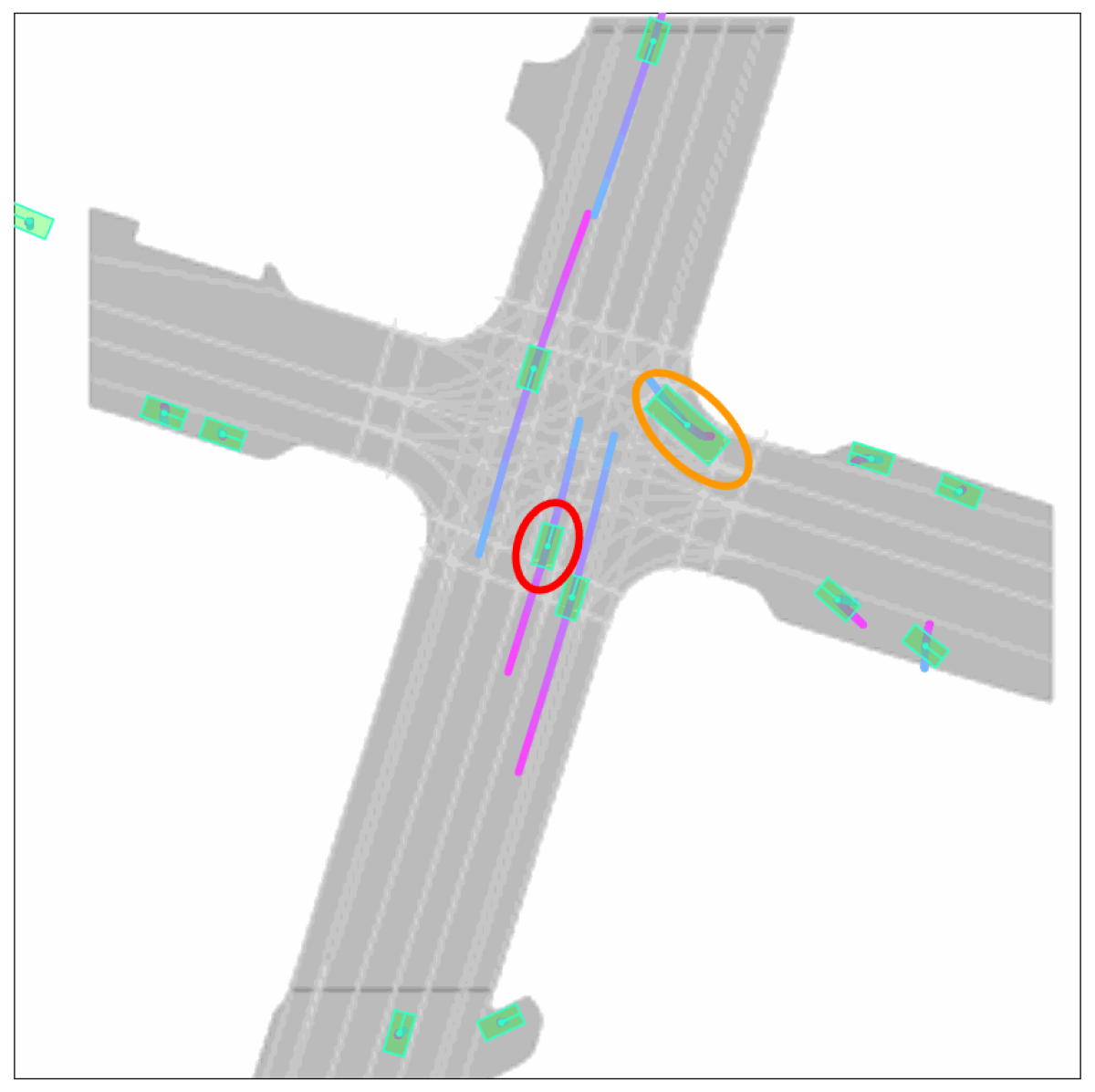
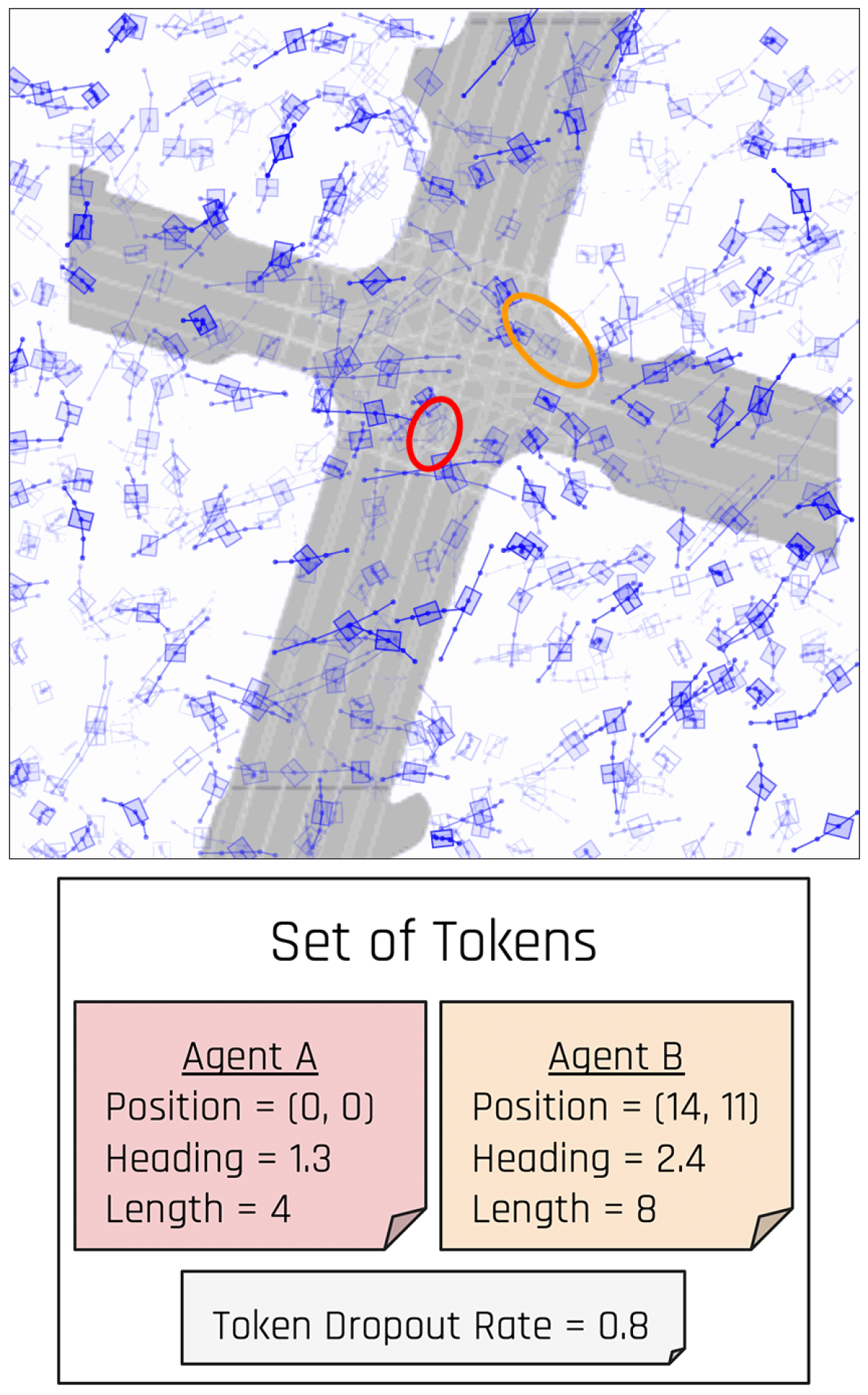
The model is provided with a map and a set of tokens that define the characteristics of an autonomous vehicle (agent A, red) and a bus (agent B, orange) turning right up ahead.
Scenario diffusion.gif
In the diffusion part of the process, the scenario undergoes multiple rounds of de-noising until a realistic scenario featuring the specified vehicles emerges.
Scenario diffusion bounding boxes.png
The final scenario shows trajectories that extend from two seconds in the past (pink) to two seconds into the future (blue).

Imagine we want to validate how an AV will behave in a safety-critical situation — such as a bus turning right in front of it — on a given map. Creating such scenarios is straightforward for Scenario Diffusion, thanks to its use of agent tokens and global scene tokens. Agent tokens can easily be computed from data in real-life driving logs or created by humans. Then they can be used to prompt the model to place vehicles with desired characteristics in specific locations. The model will include those vehicles in its generated scenarios while creating additional agents to fill out the rest of the scene in a realistic manner.

With just one GPU, it takes about one second to generate a novel scenario.

Successful generalization across regions

To evaluate our model’s ability to generalize across geographical regions, we trained separate models on data from each region of the Zoox dataset. A model trained solely on driving logs from, say, San Francisco did better at generating realistic driving scenarios for San Francisco than a model trained on data from Seattle. However, models trained on the full Zoox dataset of four regions come very close to the performance of region-specialized models. These findings suggest that, while there are unique aspects of each region, the fully trained model has sufficient capacity to capture this diversity.

The ability to generalize to other cities is good news for the future of AV validation as Zoox expands into new metropolitan areas. It will always be necessary to collect real-world driving logs in new locations, using AVs outfitted with our full sensor architecture and monitored by a safety driver. However, the ability to generate supplementary synthetic data will shorten the time it takes to validate our AV control system in new areas.

We plan to build on this research by making the model’s output increasingly rich and nuanced, with a greater diversity of vehicle and object types, to better match the complexity of real streets. For example, we could ultimately design a model to generate highly complex safety scenarios, such as driving by a school location at dismissal time, with crowds of kids and parents near or spilling onto the road.

It is this powerful combination of flexibility, controllability, and increasing realism that we believe will make our Scenario Diffusion approach foundational to the future of safety validation for autonomous vehicles.

Acknowledgments: Meghana Reddy Ganesina, Noureldin Hendy, Zeyu Wang, Andres Morales, Nicholas Roy.

Research areas

Related content

US, CA, San Francisco
The Artificial General Intelligence (AGI) team is looking for a passionate, talented, and inventive Member of Technical Staff with a strong deep learning background, to build industry-leading Generative Artificial Intelligence (GenAI) technology with Large Language Models (LLMs) and multimodal systems. Key job responsibilities As a Member of Technical Staff with the AGI team, you will lead the development of algorithms and modeling techniques, to advance the state of the art with LLMs. You will lead the foundational model development in an applied research role, including model training, dataset design, and pre- and post-training optimization. Your work will directly impact our customers in the form of products and services that make use of GenAI technology. You will leverage Amazon’s heterogeneous data sources and large-scale computing resources to accelerate advances in LLMs. About the team The AGI team has a mission to push the envelope in GenAI with LLMs and multimodal systems, in order to provide the best-possible experience for our customers.
US, CA, San Francisco
The Artificial General Intelligence (AGI) team is looking for a passionate, talented, and inventive Member of Technical Staff with a strong deep learning background, to build industry-leading Generative Artificial Intelligence (GenAI) technology with Large Language Models (LLMs) and multimodal systems. Key job responsibilities As a Member of Technical Staff with the AGI team, you will lead the development of algorithms and modeling techniques, to advance the state of the art with LLMs. You will lead the foundational model development in an applied research role, including model training, dataset design, and pre- and post-training optimization. Your work will directly impact our customers in the form of products and services that make use of GenAI technology. You will leverage Amazon’s heterogeneous data sources and large-scale computing resources to accelerate advances in LLMs. About the team The AGI team has a mission to push the envelope in GenAI with LLMs and multimodal systems, in order to provide the best-possible experience for our customers.
US, CA, San Francisco
The Artificial General Intelligence (AGI) team is looking for a passionate, talented, and inventive Member of Technical Staff with a strong deep learning background, to build industry-leading Generative Artificial Intelligence (GenAI) technology with Large Language Models (LLMs) and multimodal systems. Key job responsibilities As a Member of Technical Staff with the AGI team, you will lead the development of algorithms and modeling techniques, to advance the state of the art with LLMs. You will lead the foundational model development in an applied research role, including model training, dataset design, and pre- and post-training optimization. Your work will directly impact our customers in the form of products and services that make use of GenAI technology. You will leverage Amazon’s heterogeneous data sources and large-scale computing resources to accelerate advances in LLMs. About the team The AGI team has a mission to push the envelope in GenAI with LLMs and multimodal systems, in order to provide the best-possible experience for our customers.
US, CA, San Francisco
The Artificial General Intelligence (AGI) team is looking for a passionate, talented, and inventive Member of Technical Staff with a strong deep learning background, to build industry-leading Generative Artificial Intelligence (GenAI) technology with Large Language Models (LLMs) and multimodal systems. Key job responsibilities As a Member of Technical Staff with the AGI team, you will lead the development of algorithms and modeling techniques, to advance the state of the art with LLMs. You will lead the foundational model development in an applied research role, including model training, dataset design, and pre- and post-training optimization. Your work will directly impact our customers in the form of products and services that make use of GenAI technology. You will leverage Amazon’s heterogeneous data sources and large-scale computing resources to accelerate advances in LLMs. About the team The AGI team has a mission to push the envelope in GenAI with LLMs and multimodal systems, in order to provide the best-possible experience for our customers.
US, CA, San Francisco
The Artificial General Intelligence (AGI) team is looking for a passionate, talented, and inventive Member of Technical Staff with a strong deep learning background, to build industry-leading Generative Artificial Intelligence (GenAI) technology with Large Language Models (LLMs) and multimodal systems. Key job responsibilities As a Member of Technical Staff with the AGI team, you will lead the development of algorithms and modeling techniques, to advance the state of the art with LLMs. You will lead the foundational model development in an applied research role, including model training, dataset design, and pre- and post-training optimization. Your work will directly impact our customers in the form of products and services that make use of GenAI technology. You will leverage Amazon’s heterogeneous data sources and large-scale computing resources to accelerate advances in LLMs. About the team The AGI team has a mission to push the envelope in GenAI with LLMs and multimodal systems, in order to provide the best-possible experience for our customers.
US, CA, Sunnyvale
Prime Video is a first-stop entertainment destination offering customers a vast collection of premium programming in one app available across thousands of devices. Prime members can customize their viewing experience and find their favorite movies, series, documentaries, and live sports – including Amazon MGM Studios-produced series and movies; licensed fan favorites; and programming from Prime Video add-on subscriptions such as Apple TV+, Max, Crunchyroll and MGM+. All customers, regardless of whether they have a Prime membership or not, can rent or buy titles via the Prime Video Store, and can enjoy even more content for free with ads. Are you interested in shaping the future of entertainment? Prime Video's technology teams are creating best-in-class digital video experience. As a Prime Video technologist, you’ll have end-to-end ownership of the product, user experience, design, and technology required to deliver state-of-the-art experiences for our customers. You’ll get to work on projects that are fast-paced, challenging, and varied. You’ll also be able to experiment with new possibilities, take risks, and collaborate with remarkable people. We’ll look for you to bring your diverse perspectives, ideas, and skill-sets to make Prime Video even better for our customers. With global opportunities for talented technologists, you can decide where a career Prime Video Tech takes you! We are looking for a self-motivated, passionate and resourceful Sr. Applied Scientists with Recommender System or Search Ranking or Ads Ranking experience to bring diverse perspectives, ideas, and skill-sets to make Prime Video even better for our customers. You will spend your time as a hands-on machine learning practitioner and a research leader. You will play a key role on the team, building and guiding machine learning models from the ground up. At the end of the day, you will have the reward of seeing your contributions benefit millions of Amazon.com customers worldwide. Key job responsibilities - Develop AI solutions for various Prime Video Recommendation/Search systems using Deep learning, GenAI, Reinforcement Learning, and optimization methods; - Work closely with engineers and product managers to design, implement and launch AI solutions end-to-end; - Design and conduct offline and online (A/B) experiments to evaluate proposed solutions based on in-depth data analyses; - Effectively communicate technical and non-technical ideas with teammates and stakeholders; - Stay up-to-date with advancements and the latest modeling techniques in the field; - Publish your research findings in top conferences and journals. About the team Prime Video Recommendation/Search Science team owns science solution to power search experience on various devices, from sourcing, relevance, ranking, to name a few. We work closely with the engineering teams to launch our solutions in production.
US, WA, Seattle
Amazon's Price Perception and Evaluation team is seeking a driven Principal Applied Scientist to harness planet scale multi-modal datasets, and navigate a continuously evolving competitor landscape, in order to build and scale an advanced self-learning scientific price estimation and product understanding system, regularly generating fresh customer-relevant prices on billions of Amazon and Third Party Seller products worldwide. We are looking for a talented, organized, and customer-focused technical leader with a charter to derive deep neural product relationships, quantify substitution and complementarity effects, and publish trust-preserving probabilistic price ranges on all products listed on Amazon. This role requires an individual with excellent scientific modeling and system design skills, bar-raising business acumen, and an entrepreneurial spirit. We are looking for an experienced leader who is a self-starter comfortable with ambiguity, demonstrates strong attention to detail, and has the ability to work in a fast-paced and ever-changing environment. Key job responsibilities - Develop the team. Mentor a highly talented group of applied machine learning scientists & researchers. - See the big picture. Shape long term vision for Amazon's science-based competitive, perception-preserving pricing techniques - Build strong collaborations. Partner with product, engineering, and science teams within Pricing & Promotions to deploy machine learning price estimation and error correction solutions at Amazon scale - Stay informed. Establish mechanisms to stay up to date on latest scientific advancements in machine learning, neural networks, natural language processing, probabilistic forecasting, and multi-objective optimization techniques. Identify opportunities to apply them to relevant Pricing & Promotions business problems - Keep innovating for our customers. Foster an environment that promotes rapid experimentation, continuous learning, and incremental value delivery. - Deliver Impact. Develop, Deploy, and Scale Amazon's next generation foundational price estimation and understanding system
US, WA, Seattle
Here at Amazon, we embrace our differences. We are committed to furthering our culture of diversity and inclusion of our teams within the organization. How do you get items to customers quickly, cost-effectively, and—most importantly—safely, in less than an hour? And how do you do it in a way that can scale? Our teams of hundreds of scientists, engineers, aerospace professionals, and futurists have been working hard to do just that! We are delivering to customers, and are excited for what’s to come. Check out more information about Prime Air on the About Amazon blog (https://www.aboutamazon.com/news/transportation/amazon-prime-air-delivery-drone-reveal-photos). If you are seeking an iterative environment where you can drive innovation, apply state-of-the-art technologies to solve real world delivery challenges, and provide benefits to customers, Prime Air is the place for you. Come work on the Amazon Prime Air Team! We are seeking a highly skilled Navigation Scientist to help develop advanced algorithms and software for our Prime Air delivery drone program. In this role, you will conduct comprehensive navigation analysis to support cross-functional decision-making, define system architecture and requirements, contribute to the development of flight algorithms, and actively identify innovative technological opportunities that will drive significant enhancements to meet our customers' evolving demands. Export Control License: This position may require a deemed export control license for compliance with applicable laws and regulations. Placement is contingent on Amazon’s ability to apply for and obtain an export control license on your behalf.
IN, KA, Bengaluru
Alexa+ is Amazon’s next-generation, AI-powered virtual assistant. Building on the original Alexa, it uses generative AI to deliver a more conversational, personalized, and effective experience. As an Applied Scientist II on the Alexa Sensitive Content Intelligence (ASCI) team, you'll be part of an elite group developing industry-leading technologies in attribute extraction and sensitive content detection that work seamlessly across all languages and countries. In this role, you'll join a team of exceptional scientists pushing the boundaries of Natural Language Processing. Working in our dynamic, fast-paced environment, you'll develop novel algorithms and modeling techniques that advance the state of the art in NLP. Your innovations will directly shape how millions of customers interact with Amazon Echo, Echo Dot, Echo Show, and Fire TV devices every day. What makes this role exciting is the unique blend of scientific innovation and real-world impact. You'll be at the intersection of theoretical research and practical application, working alongside talented engineers and product managers to transform breakthrough ideas into customer-facing experiences. Your work will be crucial in ensuring Alexa remains at the forefront of AI technology while maintaining the highest standards of trust and safety. We're looking for a passionate innovator who combines strong technical expertise with creative problem-solving skills. Your deep understanding of NLP models (including LSTM and transformer-based architectures) will be essential in tackling complex challenges and identifying novel solutions. You'll leverage your exceptional technical knowledge, strong Computer Science fundamentals, and experience with large-scale distributed systems to create reliable, scalable, and high-performance products that delight our customers. Key job responsibilities In this dynamic role, you'll design and implement GenAI solutions that define the future of AI interaction. You'll pioneer novel algorithms, conduct ground breaking experiments, and optimize user experiences through innovative approaches to sensitive content detection and mitigation. Working alongside exceptional engineers and scientists, you'll transform theoretical breakthroughs into practical, scalable solutions that strengthen user trust in Alexa globally. You'll also have the opportunity to mentor rising talent, contributing to Amazon's culture of scientific excellence while helping build high-performing teams that deliver swift, impactful results. A day in the life Imagine starting your day collaborating with brilliant minds on advancing state-of-the-art NLP algorithms, then moving on to analyze experiment results that could reshape how Alexa understands and responds to users. You'll partner with cross-functional teams - from engineers to product managers - to ensure data quality, refine policies, and enhance model performance. Your expertise will guide technical discussions, shape roadmaps, and influence key platform features that require cross-team leadership. About the team The mission of the Alexa Sensitive Content Intelligence (ASCI) team is to (1) minimize negative surprises to customers caused by sensitive content, (2) detect and prevent potential brand-damaging interactions, and (3) build customer trust through appropriate interactions on sensitive topics. The term “sensitive content” includes within its scope a wide range of categories of content such as offensive content (e.g., hate speech, racist speech), profanity, content that is suitable only for certain age groups, politically polarizing content, and religiously polarizing content. The term “content” refers to any material that is exposed to customers by Alexa (including both 1P and 3P experiences) and includes text, speech, audio, and video.
IN, KA, Bengaluru
Alexa+ is Amazon’s next-generation, AI-powered virtual assistant. Building on the original Alexa, it uses generative AI to deliver a more conversational, personalized, and effective experience. As an Applied Scientist II on the Alexa Sensitive Content Intelligence (ASCI) team, you'll be part of an elite group developing industry-leading technologies in attribute extraction and sensitive content detection that work seamlessly across all languages and countries. In this role, you'll join a team of exceptional scientists pushing the boundaries of Natural Language Processing. Working in our dynamic, fast-paced environment, you'll develop novel algorithms and modeling techniques that advance the state of the art in NLP. Your innovations will directly shape how millions of customers interact with Amazon Echo, Echo Dot, Echo Show, and Fire TV devices every day. What makes this role exciting is the unique blend of scientific innovation and real-world impact. You'll be at the intersection of theoretical research and practical application, working alongside talented engineers and product managers to transform breakthrough ideas into customer-facing experiences. Your work will be crucial in ensuring Alexa remains at the forefront of AI technology while maintaining the highest standards of trust and safety. We're looking for a passionate innovator who combines strong technical expertise with creative problem-solving skills. Your deep understanding of NLP models (including LSTM and transformer-based architectures) will be essential in tackling complex challenges and identifying novel solutions. You'll leverage your exceptional technical knowledge, strong Computer Science fundamentals, and experience with large-scale distributed systems to create reliable, scalable, and high-performance products that delight our customers. Key job responsibilities In this dynamic role, you'll design and implement GenAI solutions that define the future of AI interaction. You'll pioneer novel algorithms, conduct ground breaking experiments, and optimize user experiences through innovative approaches to sensitive content detection and mitigation. Working alongside exceptional engineers and scientists, you'll transform theoretical breakthroughs into practical, scalable solutions that strengthen user trust in Alexa globally. You'll also have the opportunity to mentor rising talent, contributing to Amazon's culture of scientific excellence while helping build high-performing teams that deliver swift, impactful results. A day in the life Imagine starting your day collaborating with brilliant minds on advancing state-of-the-art NLP algorithms, then moving on to analyze experiment results that could reshape how Alexa understands and responds to users. You'll partner with cross-functional teams - from engineers to product managers - to ensure data quality, refine policies, and enhance model performance. Your expertise will guide technical discussions, shape roadmaps, and influence key platform features that require cross-team leadership. About the team The mission of the Alexa Sensitive Content Intelligence (ASCI) team is to (1) minimize negative surprises to customers caused by sensitive content, (2) detect and prevent potential brand-damaging interactions, and (3) build customer trust through appropriate interactions on sensitive topics. The term “sensitive content” includes within its scope a wide range of categories of content such as offensive content (e.g., hate speech, racist speech), profanity, content that is suitable only for certain age groups, politically polarizing content, and religiously polarizing content. The term “content” refers to any material that is exposed to customers by Alexa (including both 1P and 3P experiences) and includes text, speech, audio, and video.