Runtime optimizations and a thorough evaluation process driven by agentic AI help ensure that models written in PyTorch will execute efficiently and reliably on Trainium systems.

Using the Neuron Kernel Interface, a Reactor–AWS collaboration tackled the dynamic shapes, memory access patterns, and cache management that make real-time autoregressive diffusion hard—building techniques that generalize across models.


Three new papers from Amazon Bio Discovery address bottlenecks in AI-driven antibody engineering, from benchmarking binding predictors to experimentally validating de novo design.
New research indicates that AI agents learn compressible models of data, which don’t have enough space to enable memorization.

How the Verus "program verifier", which automatically checks code against a mathematical specification of its functionality, helps increase security assurance in software projects.

Ten years after we founded the Automated Reasoning Group, mathematical logic has moved from academic research into production services that secure millions of customer workloads — demonstrating that systems can be provably correct, not just probably correct.
Customer-obsessed science

Research areas


-
 November 5, 20266 min readAmazon senior applied scientist and coauthors showed that an overlooked mathematical condition from 1963 proves why frequently used machine-learning optimization methods work well.
-

-
-
October 20, 20263 min read
-
October 12, 202614 min read


Featured news

The collaboration aims to advance research while broadening participation and translating discovery into real-world solutions.

Submissions open October 1 and close on November 11, 2026

The collaboration will support research in robotics, industrial and systems engineering, and aerospace technology while fostering innovation in foundational and emerging technologies.

The Build on Trainium program is a $110 million credit initiative supporting AI research at 30 universities including Stanford, UC Berkeley, UIUC, UCLA, CMU, and MIT, with a focus on Responsible AI.

The Antibody Developability Benchmark is powered by one of the most diverse antibody datasets in public literature, enabling transparent performance evaluation for AI-guided antibody design.

Challenge pushes teams to demonstrate measurable gains in secure-coding performance while building AI agents that advance real-world utility and reliability at scale.

Initiative will fund over 100 doctoral students researching machine learning, computer vision, and natural-language processing at nine universities.
-
ACL 2020 Workshop on NLP for Conversational AI2020Dialogue response generation models that use template ranking rather than direct sequence generation allow model developers to limit generated responses to pre-approved messages. However, manually creating templates is time consuming and requires domain expertise. To alleviate this problem, we explore automating the process of creating dialogue templates by using unsupervised methods to cluster historical
-
ACM Transactions on Graphics2020Nowadays, as cameras are rapidly adopted in our daily routine, images of documents are becoming both abundant and prevalent. Unlike natural images that capture physical objects, document-images contain a significant amount of text with critical semantics and complicated layouts. In this work, we devise a generic unsupervised technique to learn multimodal affinities between textual entities in a document-image
-
arXiv2020We study whether one can write a Matrix Product Density Operator (MPDO) as the Gibbs state of a quasi-local parent Hamiltonian. We conjecture this is the case for generic MPDO and give supporting evidences. To investigate the locality of the parent Hamiltonian, we take the approach of checking whether the quantum conditional mutual information decays exponentially. The MPDO we consider are constructed from
-
ACM CHIL 20202020Electronic records contain sequences of events, some of which take place all at once in a single visit, and others that are dispersed over multiple visits, each with a different timestamp. We postulate that fine temporal detail, e.g., whether a series of blood tests are completed at once or in rapid succession should not alter predictions based on this data. Motivated by this intuition, we propose models
-
Transactions of the Association for Computational Linguistics2020Recent work has shown that pre-trained language models such as BERT improve robustness to spurious correlations in the dataset. Intrigued by these results, we find that the key to their success is generalization from a small amount of counter examples where the spurious correlations do not hold. When such minority examples are scarce, pre-trained models perform as poorly as models trained from scratch.
Collaborations
View allWhether you're a faculty member or student, there are number of ways you can engage with Amazon.
View all

Gretchen Ertl
The program offers unrestricted funds and other resources to support research at academic institutions and non-profit organizations in areas that align with our mission.
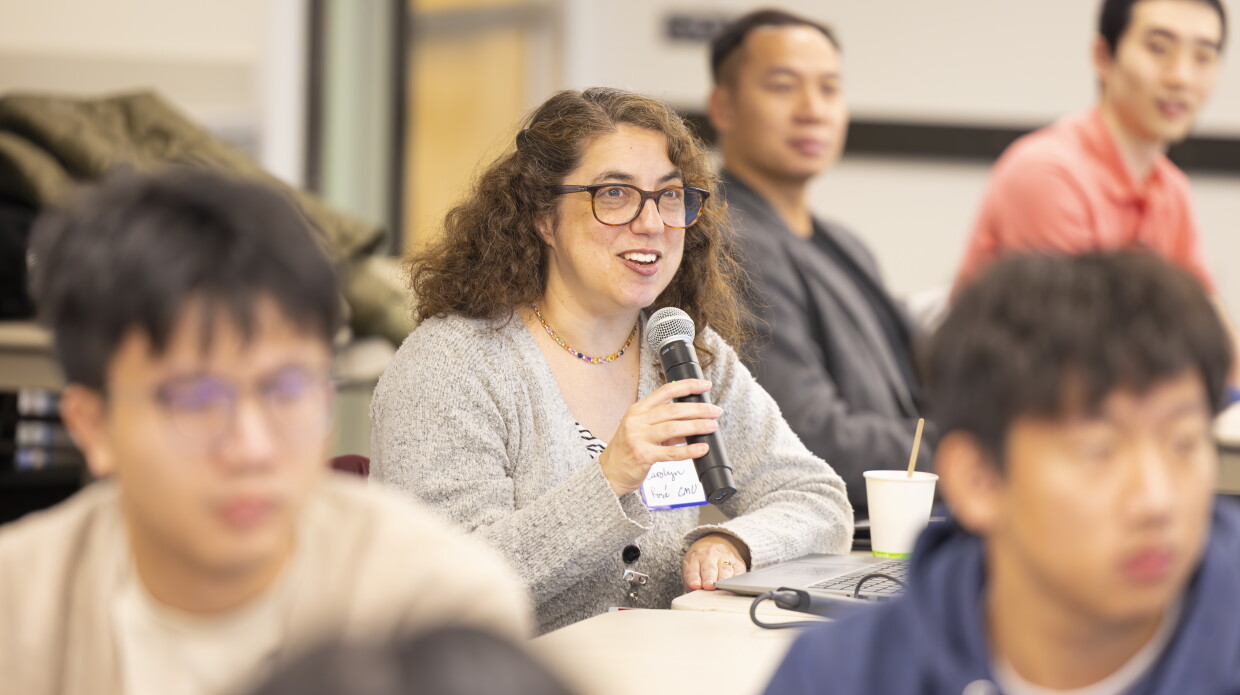
A global university competition to drive secure innovation in generative AI technology, which focuses on responsible AI and large language model coding security.

Credit: Wolfram Scheible
We partner with particular academic organizations across the world for deep and sustained collaborations in multiple research areas of mutual interest.
Courtesy of Pai-Ling Yin
We hire world-class academics to work on large-scale technical challenges, while they continue to teach and conduct research at their universities.