


Runtime optimizations and a thorough evaluation process driven by agentic AI help ensure that models written in PyTorch will execute efficiently and reliably on Trainium systems.

Using the Neuron Kernel Interface, a Reactor–AWS collaboration tackled the dynamic shapes, memory access patterns, and cache management that make real-time autoregressive diffusion hard—building techniques that generalize across models.


Three new papers from Amazon Bio Discovery address bottlenecks in AI-driven antibody engineering, from benchmarking binding predictors to experimentally validating de novo design.

New research indicates that AI agents learn compressible models of data, which don’t have enough space to enable memorization.

How the Verus "program verifier", which automatically checks code against a mathematical specification of its functionality, helps increase security assurance in software projects.

Ten years after we founded the Automated Reasoning Group, mathematical logic has moved from academic research into production services that secure millions of customer workloads — demonstrating that systems can be provably correct, not just probably correct.
Customer-obsessed science

Research areas


-
 October 29, 20265 min readTwo optimization techniques, when combined, can significantly improve a model’s speed and cost effectiveness without sacrificing quality.
-

-
October 20, 20263 min read
-
October 12, 202614 min read
-


Featured news

The collaboration aims to advance research while broadening participation and translating discovery into real-world solutions.

Submissions open October 1 and close on November 11, 2026

The collaboration will support research in robotics, industrial and systems engineering, and aerospace technology while fostering innovation in foundational and emerging technologies.

The Build on Trainium program is a $110 million credit initiative supporting AI research at 30 universities including Stanford, UC Berkeley, UIUC, UCLA, CMU, and MIT, with a focus on Responsible AI.

The Antibody Developability Benchmark is powered by one of the most diverse antibody datasets in public literature, enabling transparent performance evaluation for AI-guided antibody design.

Challenge pushes teams to demonstrate measurable gains in secure-coding performance while building AI agents that advance real-world utility and reliability at scale.

Initiative will fund over 100 doctoral students researching machine learning, computer vision, and natural-language processing at nine universities.
-
ACL 20202020Question answering (QA) is an important aspect of open-domain conversational agents, garnering specific research focus in the conversational QA (ConvQA) subtask. One no-table limitation of recent ConvQA efforts is the response being answer span extraction from the target corpus, thus ignoring the natural language generation (NLG) aspect of high-quality conversational agents. In this work, we propose a method
-
ACL 20202020One of the core components of voice assistants is the Natural Language Understanding (NLU) model. Its ability to accurately classify the user’s request (or “intent”) and recognize named entities in an utterance is pivotal to the success of these assistants. NLU models can be challenged in some languages by code-switching or morphological and orthographic variations. This work explores the possibility of
-
ICLR 20202020Channel pruning is one of the predominant approaches for accelerating deep neural networks. Most existing pruning methods either train from scratch with a sparsity inducing term such as group lasso, or prune redundant channels in a pretrained network and then fine tune the network. Both strategies suffer from some limitations: the use of group lasso is computationally expensive, difficult to converge and
-
ACL 20202020Non-autoregressive (NAR) neural machine translation is usually done via knowledge distillation from an autoregressive (AR) model. Under this framework, we leverage large monolingual corpora to improve the NAR model’s performance, with the goal of transferring the AR model’s generalization ability while preventing overfitting. On top of a strong NAR baseline, our experimental results on the WMT14 En-De and
-
SIGMOD/PODS 20202020Enterprise companies use spatial data for decision optimization and gain new insights regarding the locality of their business and services. Industries rely on efficiently combining spatial and business data from different sources, such as data warehouses, geospatial information systems, transactional systems, and data lakes, where spatial data can be found in structured or unstructured form. In this demonstration
Collaborations
View allWhether you're a faculty member or student, there are number of ways you can engage with Amazon.
View all

Gretchen Ertl
The program offers unrestricted funds and other resources to support research at academic institutions and non-profit organizations in areas that align with our mission.

A global university competition to drive secure innovation in generative AI technology, which focuses on responsible AI and large language model coding security.

Credit: Wolfram Scheible
We partner with particular academic organizations across the world for deep and sustained collaborations in multiple research areas of mutual interest.
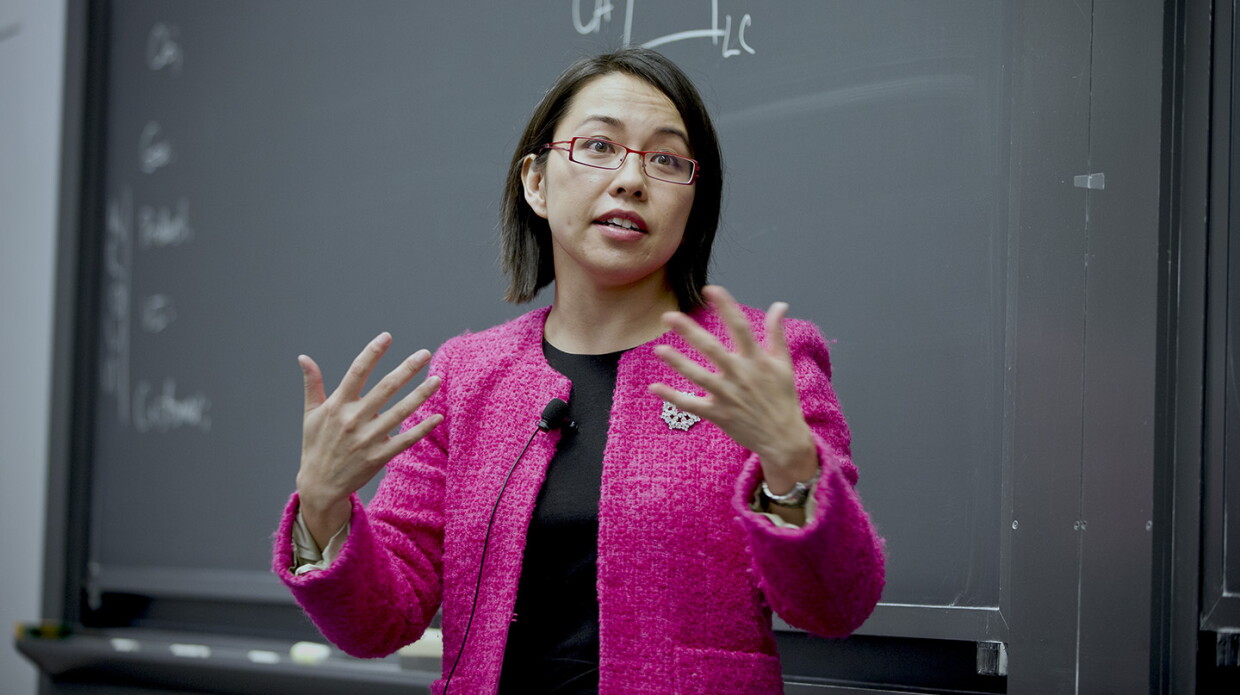
Courtesy of Pai-Ling Yin
We hire world-class academics to work on large-scale technical challenges, while they continue to teach and conduct research at their universities.

