














Reasoning models can generate seven to 10 times as many tokens as necessary on simple tasks, creating unsustainable costs at scale. Amazon's vision for metacognitive AI could fundamentally shift how models allocate computational resources.

Amazon's competitive-agent architecture creates a continuous improvement cycle that develops security protections at machine speed, reducing what typically takes weeks down to hours.


A new approach to reducing carbon emissions reveals previously hidden emission “hotspots” within value chains, helping organizations make more detailed and dynamic decisions about their future carbon footprints.

How agentic systems work under the hood — and how AWS’s new AgentCore framework implements their essential components.
Customer-obsessed science


Research areas


-
 December 1, 20258 min read“Network language models” will coordinate complex interactions among intelligent components, computational infrastructure, access points, data centers, and more.
 -

-
November 20, 20254 min read
-
October 20, 20254 min read
-
October 14, 20257 min read


Featured news
Initiative will fund over 100 doctoral students researching machine learning, computer vision, and natural-language processing at nine universities.
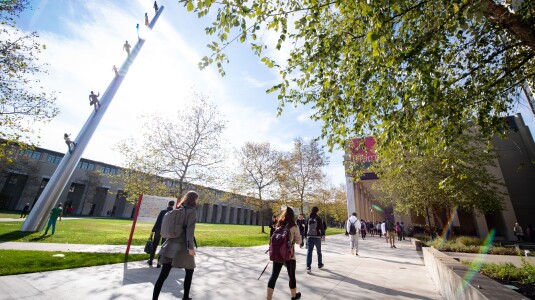
The collaboration will advance research in generative AI, robotics, natural language processing and cloud computing while fostering innovation in foundational and emerging technologies.
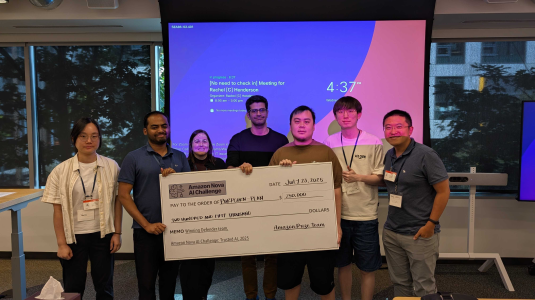
University teams battle to harden and hack AI coding assistants in head-to-head tournament

David Chang/Getty Images/iStockphoto
Led by David Luan and Pieter Abbeel, the lab will focus on developing new foundational capabilities for enabling useful AI agents.

The company's new state-of-the-art foundation models deliver frontier intelligence and industry-leading price performance.
-
NeurIPS 2022 Workshop on Trustworthy and Socially Responsible Machine Learning (TSRML)2022We study the problem of differentially private (DP) fine-tuning of large pre-trained models — a recent privacy-preserving approach suitable for solving downstream tasks with sensitive data. Existing work has demonstrated that high accuracy is possible under strong privacy constraint, yet requires significant computational overhead or modifications to the network architecture. We propose differentially private
-
NeurIPS 2022 Workshop on Score-Based Methods2022Kernel Stein discrepancies (KSDs) are maximum mean discrepancies (MMDs) that leverage the score information of distributions, and have grown central to a wide range of applications. In most settings, these MMDs are required to (i) separate a target P from other probability measures or even (ii) control weak convergence to P. In this article we derive new sufficient and necessary conditions that substantially
-
ACL 20222022The goal of meta-learning is to learn to adapt to a new task with only a few labeled examples. Inspired by the recent progress in large language models, we propose in-context tuning (ICT), which recasts task adaptation and prediction as a simple sequence prediction problem: to form the input sequence, we concatenate the task instruction, labeled in-context examples, and the target input to predict; to metatrain
-
Science2022Realizing quantum speedup for practically relevant, computationally hard problems is a central challenge in quantum information science. Using Rydberg atom arrays with up to 289 qubits in two spatial dimensions, we experimentally investigate quantum algorithms for solving the maximum independent set problem. We use a hardware-efficient encoding associated with Rydberg blockade, realize closed-loop optimization
-
Nature Communications2022Due to intense interest in the potential applications of quantum computing, it is critical to understand the basis for potential exponential quantum advantage in quantum chemistry. Here we gather the evidence for this case in the most common task in quantum chemistry, namely, ground-state energy estimation, for generic chemical problems where heuristic quantum state preparation might be assumed to be efficient
Collaborations
View allWhether you're a faculty member or student, there are number of ways you can engage with Amazon.
View all

Gretchen Ertl
The program offers unrestricted funds and other resources to support research at academic institutions and non-profit organizations in areas that align with our mission.
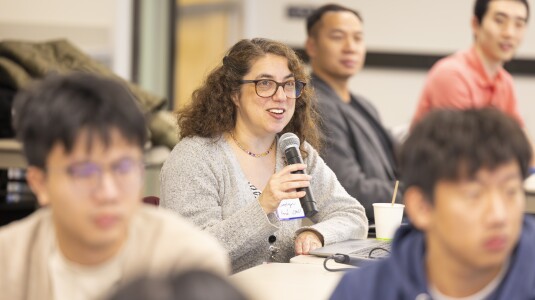
A global university competition to drive secure innovation in generative AI technology, which focuses on responsible AI and large language model coding security.

Credit: Wolfram Scheible
We partner with particular academic organizations across the world for deep and sustained collaborations in multiple research areas of mutual interest.
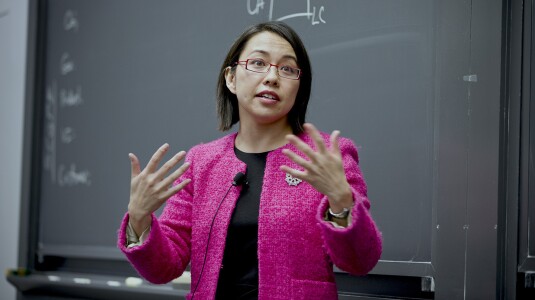
Courtesy of Pai-Ling Yin
We hire world-class academics to work on large-scale technical challenges, while they continue to teach and conduct research at their universities.

