














Reasoning models can generate seven to 10 times as many tokens as necessary on simple tasks, creating unsustainable costs at scale. Amazon's vision for metacognitive AI could fundamentally shift how models allocate computational resources.

Amazon's competitive-agent architecture creates a continuous improvement cycle that develops security protections at machine speed, reducing what typically takes weeks down to hours.


A new approach to reducing carbon emissions reveals previously hidden emission “hotspots” within value chains, helping organizations make more detailed and dynamic decisions about their future carbon footprints.

How agentic systems work under the hood — and how AWS’s new AgentCore framework implements their essential components.
Customer-obsessed science


Research areas


-
 December 1, 20258 min read“Network language models” will coordinate complex interactions among intelligent components, computational infrastructure, access points, data centers, and more.
 -

-
November 20, 20254 min read
-
October 20, 20254 min read
-
October 14, 20257 min read


Featured news
Initiative will fund over 100 doctoral students researching machine learning, computer vision, and natural-language processing at nine universities.
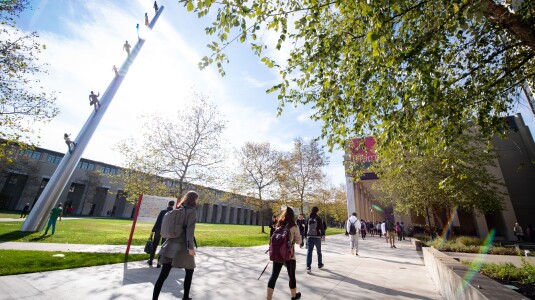
The collaboration will advance research in generative AI, robotics, natural language processing and cloud computing while fostering innovation in foundational and emerging technologies.
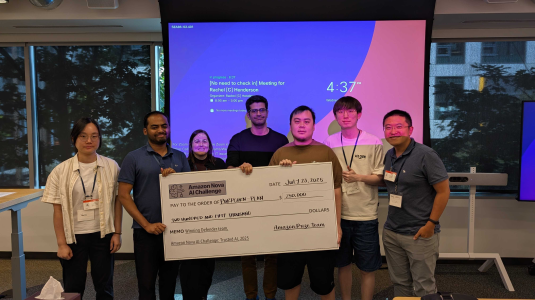
University teams battle to harden and hack AI coding assistants in head-to-head tournament

David Chang/Getty Images/iStockphoto
Led by David Luan and Pieter Abbeel, the lab will focus on developing new foundational capabilities for enabling useful AI agents.

The company's new state-of-the-art foundation models deliver frontier intelligence and industry-leading price performance.
-
Quantum2022A highly anticipated use of quantum computers is the simulation of complex quantum systems including molecules and other many-body systems. One promising method involves directly applying a linear combination of unitaries (LCU) to approximate a Taylor series by truncating after some order. Here we present an adaptation of that method, optimized for Hamiltonians with terms of widely varying magnitude, as
-
Optics Express2022Diamond offers good optical properties and hosts bright color centers with long spin coherence times. Recent advances in angled-etching of diamond, specifically with reactive ion beam angled etching (RIBAE), have led to successful demonstration of quantum photonic devices operating at visible wavelengths. However, larger devices operating at telecommunication wavelengths have been difficult to fabricate
-
JSM 20222022Measurements of a physical quantity by measuring devices are usually noisy enough that we need to correct, or at least mitigate, the effects of noise. For this purpose, it’s important to distinguish between systematic and random noise since they are of a different nature and independent from each other (when defined properly), so should be dealt with differently. For example, random noise can be significantly
-
PRX Quantum2022We introduce a morphing procedure that can be used to generate new quantum codes from existing quantum codes. In particular, we morph the 15-qubit Reed-Muller code to obtain a [[10,1,2]] code that is the smallest-known stabilizer code with a fault-tolerant logical T gate. In addition, we construct a family of hybrid color-toric codes by morphing the color code. Our code family inherits the fault-tolerant
-
Physical Review Applied2022Universal fault-tolerant quantum computers will require the use of efficient protocols to implement encoded operations necessary in the execution of algorithms. In this work, we show how SMT solvers can be used to automate the construction of Clifford circuits with certain fault-tolerance properties and we apply our techniques to a fault-tolerant magic-state-preparation protocol. Part of the protocol requires
Collaborations
View allWhether you're a faculty member or student, there are number of ways you can engage with Amazon.
View all

Gretchen Ertl
The program offers unrestricted funds and other resources to support research at academic institutions and non-profit organizations in areas that align with our mission.
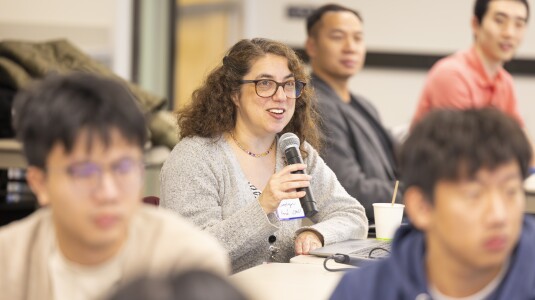
A global university competition to drive secure innovation in generative AI technology, which focuses on responsible AI and large language model coding security.
Credit: Wolfram Scheible
We partner with particular academic organizations across the world for deep and sustained collaborations in multiple research areas of mutual interest.
Courtesy of Pai-Ling Yin
We hire world-class academics to work on large-scale technical challenges, while they continue to teach and conduct research at their universities.

