Amazon's Tal Rabin wins Dijkstra Prize in Distributed Computing

Prize honors Amazon senior principal scientist and Penn professor for a protocol that achieves a theoretical limit on information-theoretic secure multiparty computation.

Secure multiparty computation (MPC) is a computing paradigm in which multiple parties compute an aggregate function — say, their average salary — without revealing any private information — say, their individual salaries — to each other. It’s found applications in auction design, cryptography, data analytics, digital-wallet security, and blockchain computation, among other things.

Tal Rabin.jpeg
Tal Rabin, a senior principal scientist in Amazon Web Services’ cryptography group, a professor of computer science at the University of Pennsylvania, and one of the recipients of the Association for Computing Machinery’s 2023 Dijkstra Prize in Distributed Computing.

In 2023, the Association for Computing Machinery’s annual Dijkstra Prize in Distributed Computing was awarded to three papers on secure MPC from the late 1980s. One of those papers, “Verifiable secret sharing and multiparty protocols with honest majority”, grew out of the doctoral dissertation of Tal Rabin, a senior principal scientist in Amazon Web Services’ cryptography group and a professor of computer science at the University of Pennsylvania. She’s joined on the paper by her thesis advisor, Michael Ben-Or, a professor of computer science at the Hebrew University of Jerusalem, where Rabin earned her PhD.

In a remarkable twist, Rabin’s father, Michael Rabin, also won the Dijkstra Prize, in 2015, making the Rabins the only parent-child pair to have received the award. Even more remarkably, Michael Rabin’s co-recipient was one of his PhD students — Michael Ben-Or.

“So I am my father’s academic grandchild,” Rabin says.

Information-theoretic security

The field of secure MPC got off the ground in 1982, when Andrew Yao, now a professor of computer science at Tsinghua University, published a paper on secure two-party computation. The security of Yao’s MPC scheme, however, depended on the difficulty of factoring large integers — the same computational assumption that ensures the security of most online financial transactions today. Yao’s results immediately raised the question of whether secure MPC was possible even if an adversary had unbounded computational resources, a setting known as the information-theoretic (as opposed to computational) security setting.

Related content
Both secure multiparty computation and differential privacy protect the privacy of data used in computation, but each has advantages in different contexts.

The three 2023 recipients of the Dijkstra Prize all address the problem of information-theoretic secure MPC. The first two papers, both published at the 1988 ACM Symposium on Theory of Computing (STOC), prove that information-theoretic secure MPC is possible if no more than one-third of the participants in the computation are bad-faith actors who secretly share information and collusively manipulate their results.

Tal Rabin and Michael Ben-Or’s paper, which appeared at STOC the following year, improves that ratio to (approximately) one-half, which is provably the maximum number of defectors that can be tolerated in the information-theoretic setting. It’s also the threshold that Yao proved for his original computationally bounded approach.

Today, 35 years after Rabin and Ben-Or’s paper, techniques for information-theoretic secure MPC are beginning to find application. And as general-purpose quantum computers, which can efficiently factor large numbers, inch toward reality, information-theoretic — rather than computational — cryptographic methods become more urgent.

“The goal of our team is to apply MPC techniques to improve security and privacy at Amazon,” Rabin says.

Information checking

The heart of Rabin and Ben-Or’s paper is the adaptation of the concept of a digital signature to the information-theoretic setting. A digital signature is an application of public-key cryptography: The originator of a document has a private signing key and a public verification key, both derived from the prime factors of a very large number. Computing a document’s signature requires the private key, but verifying it requires only the public key. And an adversary can’t falsify the signature without computing the number’s factors.

Rabin and Ben-Or propose a method that they call information checking, which isn’t as powerful as digital signatures but makes no assumptions about defectors’ computational limitations. And it turns out to be an adequate basis for secure multiparty computation.
Related content
Technique that mixes public and private training data can meet differential-privacy criteria while cutting error increase by 60%-70%.

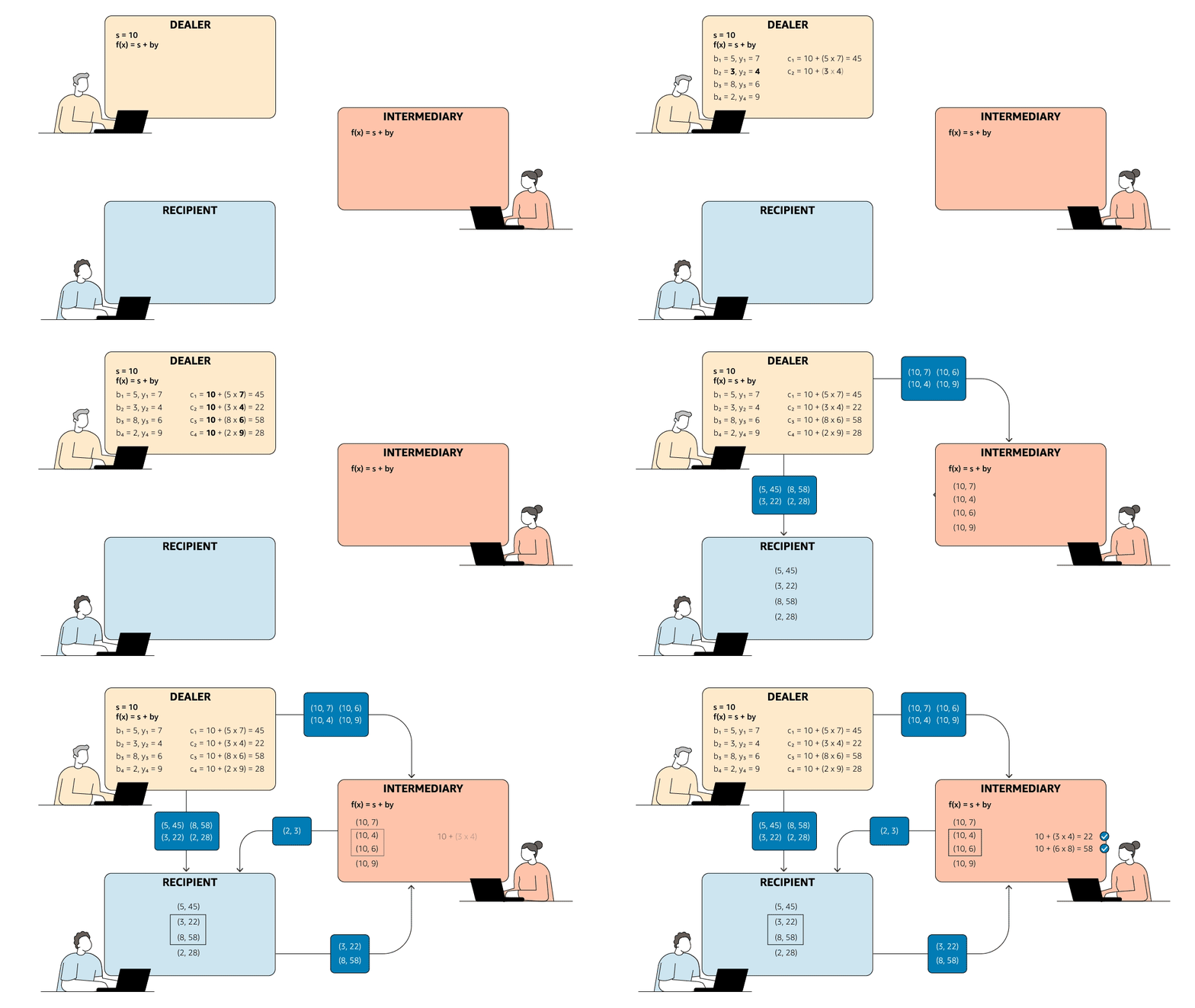
Rabin and Ben-Or’s protocol involves a dealer, an intermediary, and a recipient. The dealer has some data item, s, which it passes to the intermediary, who, at a later time, may in turn pass it to the recipient.

To mimic the security guarantees of digital signatures, information checking must meet two criteria: (1) if the dealer and recipient are honest, the recipient will always accept s if it is legitimate and will, with high probability, reject any fraudulent substitutions; and (2) whether or not the dealer is honest, the intermediary can predict with high probability whether or not the recipient will accept s. Together, these two criteria establish that fraudulent substitutions can be detected if either the dealer or the intermediary (but not both) is dishonest.

To meet the first criterion, the dealer sends the intermediary two values, s and a second number, y. It sends the recipient a different random number pair, (b, c), which satisfy an arithmetic operation (say, y = bs + c). The intermediary knows y and s but neither c nor b; if it attempts to pass the receiver a false s, the arithmetic operation will fail.

Zero-knowledge proofs

To meet the second criterion, Rabin and Ben-Or used a zero-knowledge proof, a mechanism that enables a party to prove that it knows some value without disclosing the value itself. Instead of applying an arithmetic operation to s and a single set of randomly generated numbers, the dealer applies it to s and multiple sets of randomly generated numbers, producing a number of (bi, ci) pairs. After the dealer has sent those pairs to the recipient, the intermediary selects half of them at random and asks the recipient to disclose them.

Since the intermediary knows s, it can determine whether the arithmetic relationship holds and, thus, whether the dealer has sent the recipient valid (bi, ci) pairs. On the other hand, since the intermediary doesn’t know the undisclosed pairs, it can’t, if it’s dishonest, game the system by trying to pass the recipient false y’s along with false s’s.
Secure multiparty computation.gif
A sample implementation of the zero-knowledge proof that Tal Rabin and her coauthor, Michael Ben-Or, used to establish that the intermediary in their multiparty-computation protocol could detect attempts by the dealer to cheat.

From weak to verifiable secret sharing

Next, Rabin and Ben-Or generalize this result to the situation in which there are multiple recipients, each receiving its own si. In this context, the authors show that their protocol enables weak secret sharing, meaning that if the recipients are trying to collectively reconstruct a value from their respective si’s, either they’ll reconstruct the correct value, or the computation will fail.

Providing a basis for secure MPC, however, requires the stronger standard of verifiable secret sharing, meaning that no matter the interference, the recipients’ collective reconstruction will succeed. The second major contribution made by Rabin and Ben-Or’s paper is a method for leveraging weak secret sharing to enable verifiable secret sharing.
Related content
Amazon is helping develop standards for post-quantum cryptography and deploying promising technologies for customers to experiment with.

In Rabin and Ben-Or’s protocol, all the (bi, ci) pairs sent to all the recipients are generated using the same polynomial function. In the multiple-recipient setting, the degree of the polynomial — its largest exponent — is half the number of recipients. To establish that a secret has been correctly shared, the dealer needs to show that all the received pairs fit the polynomial — without disclosing the polynomial itself. Again, the mechanism is a zero-knowledge proof.

“What we want is for parties to commit to their values via the weak secret sharing,” Rabin explains. “So now you know it's either one value or nothing. And then the dealer, on these values, proves that they all sit on a polynomial of degree T. Once that proof is done, you know about the values shared with weak secret sharing that they'll either be opened or not opened. You know that everything that is opened is on the same polynomial of degree T. And now you know you can reconstruct.”

When Rabin and Ben-Or published their paper, MPC research was in its infancy. “You can do information checking much better, much more efficiently and so on, today,” Rabin says. But the paper’s central result was theoretical. Today, designers of secure-MPC protocols can use any proof mechanism they choose, and they’ll enjoy the same guarantees on computability and defection tolerance that Rabin and Ben-Or established 35 years ago.

Related content

US, VA, Arlington
Are you fascinated by the power of Large Language Models (LLM) and Artificial Intelligence (AI) to transform the way we learn and interact with technology? Are you passionate about applying advanced machine learning (ML) techniques to solve complex challenges in the cloud learning space? If so, AWS Training & Certification (T&C) team has an exciting opportunity for you as an Applied Scientist. At AWS T&C, we strive to be leaders in not only how we learn about the latest AI/ML development and AWS services, but also how the same technologies transform the way we learn about them. As an Applied Scientist, you will join a talented and collaborative team that is dedicated to driving innovation and delivering exceptional experiences in our Skill Builder platform for both new learners and seasoned developers. You will be a part of a global team that is focused on transforming how people learn. The position will interact with global leaders and teams across the globe as well as different business and technical organizations. Join us at the AWS T&C Science Team and become a part of a global team that is redefining the future of cloud learning. With access to vast amounts of data, exciting new technology, and a diverse community of talented individuals, you will have the opportunity to make a meaningful impact on the ways how worldwide learners engage with our learning system and builders develop on our platform. Together, we will drive innovation, solve complex problems, and shape the future of future-generation cloud builders. Please visit https://skillbuilder.awsto learn more. Key job responsibilities - Apply your expertise in LLM to design, develop, and implement scalable machine learning solutions that address challenges in discovery and engagement for our international audiences. - Collaborate with cross-functional teams, including software engineers, data engineers, scientists, and product managers, to define project requirements, establish success metrics, and deliver high-quality solutions. - Conduct thorough data analysis to gain insights, identify patterns, and drive actionable recommendations that enhance operational performance and customer experiences across Skill Builder. - Continuously explore and evaluate state-of-the-art techniques and methodologies to improve the accuracy and efficiency of AI/ML systems. - Communicate complex technical concepts effectively to both technical and non-technical stakeholders, providing clear explanations and guidance on proposed solutions and their potential impact. About the team Why AWS? Amazon Web Services (AWS) is the world’s most comprehensive and broadly adopted cloud platform. We pioneered cloud computing and never stopped innovating — that’s why customers from the most successful startups to Global 500 companies trust our robust suite of products and services to power their businesses. Inclusive Team Culture Here at AWS, it’s in our nature to learn and be curious. Our employee-led affinity groups foster a culture of inclusion that empower us to be proud of our differences. Ongoing events and learning experiences, including our Conversations on Race and Ethnicity (CORE) and AmazeCon conferences, inspire us to never stop embracing our uniqueness. Diverse Experiences AWS values diverse experiences. Even if you do not meet all of the qualifications and skills listed in the job description, we encourage candidates to apply. If your career is just starting, hasn’t followed a traditional path, or includes alternative experiences, don’t let it stop you from applying. Mentorship & Career Growth We’re continuously raising our performance bar as we strive to become Earth’s Best Employer. That’s why you’ll find endless knowledge-sharing, mentorship and other career-advancing resources here to help you develop into a better-rounded professional. Work/Life Balance We value work-life harmony. Achieving success at work should never come at the expense of sacrifices at home, which is why we strive for flexibility as part of our working culture. When we feel supported in the workplace and at home, there’s nothing we can’t achieve in the cloud.
US, MA, N.reading
Amazon Industrial Robotics is seeking exceptional talent to help develop the next generation of advanced robotics systems that will transform automation at Amazon's scale. We're building revolutionary robotic systems that combine cutting-edge AI, sophisticated control systems, and advanced mechanical design to create adaptable automation solutions capable of working safely alongside humans in dynamic environments. This is a unique opportunity to shape the future of robotics and automation at an unprecedented scale, working with world-class teams pushing the boundaries of what's possible in robotic dexterous manipulation, locomotion, and human-robot interaction. This role presents an opportunity to shape the future of robotics through innovative applications of deep learning and large language models. At Amazon Industrial Robotics we leverage advanced robotics, machine learning, and artificial intelligence to solve complex operational challenges at an unprecedented scale. Our fleet of robots operates across hundreds of facilities worldwide, working in sophisticated coordination to fulfill our mission of customer excellence. We are pioneering the development of robotics dexterous hands that: - Enable unprecedented generalization across diverse tasks - Are compliant and durable - Can span tasks from power grasps to fine dexterity and nonprehensile manipulation - Can navigate the uncertainty of the environment - Leverage mechanical intelligence, multi-modal sensor feedback and advanced control techniques. The ideal candidate will contribute to research that bridges the gap between theoretical advancement and practical implementation in robotics. You will be part of a team that's revolutionizing how robots learn, adapt, and interact with their environment. Join us in building the next generation of intelligent robotics systems that will transform the future of automation and human-robot collaboration. Key job responsibilities - Design and implement robust sensing for dexterous manipulation, including but not limited to: Tactile sensing, Position sensing, Force sensing, Non-contact sensing - Prototype the various identified sensing strategies, considering the constraints of the rest of the hand design - Build and test full hand sensing prototypes to validate the performance of the solution - Develop testing and validation strategies, supporting fast integration into the rest of the robot - Partner with cross-functional teams to iterate on concepts and prototypes - Work with Amazon's robotics engineering and operations customers to deeply understand their requirements and develop tailored solutions - Document the designs, performance, and validation of the final system
IL, Tel Aviv
Come build the future of entertainment with us. Are you interested in helping shape the future of movies and television? Do you want to help define the next generation of how and what Amazon customers are watching? Prime Video is a premium streaming service that offers customers a vast collection of TV shows and movies - all with the ease of finding what they love to watch in one place. We offer customers thousands of popular movies and TV shows from Originals and Exclusive content to exciting live sports events. We also offer our members the opportunity to subscribe to add-on channels which they can cancel at any time and to rent or buy new release movies and TV box sets on the Prime Video Store. Prime Video is a fast-paced, growth business - available in over 240 countries and territories worldwide. The team works in a dynamic environment where innovating on behalf of our customers is at the heart of everything we do. If this sounds exciting to you, please read on We are seeking an exceptional Applied Scientist to join our Prime Video Sports personalization team in Israel. Our team is dedicated to developing state-of-the-art science to personalize the customer experience and help customers seamlessly find any live event in our selection. You will have the opportunity to work on innovative, large-scale projects that push the boundaries of what's possible in sports content delivery and engagement. Your expertise will be crucial in tackling complex challenges such as information retrieval, sequential modeling, realtime model optimizations, utilizing Large Language Models (LLMs), and building state-of-the-art complex recommender systems. Key job responsibilities We are looking for an Applied Scientist with domain expertise in Personalization, Information Retrieval, and Recommender Systems, or general ML to develop new algorithms and end-to-end solutions. As part of our team of applied scientists and software development engineers, you will be responsible for researching, designing, developing, and deploying algorithms into production pipelines. Your role will involve working with cutting-edge technologies in recommender systems and search. You'll also tackle unique challenges like temporal information retrieval to improve real-time sports content recommendations. As a technologist, you will drive the publication of original work in top-tier conferences in Machine Learning and Recommender Systems. We expect you to thrive in ambiguous situations, demonstrating outstanding analytical abilities and comfort in collaborating with cross-functional teams and systems. The ideal candidate is a self-starter with the ability to learn and adapt quickly in our fast-paced environment. About the team We are the Prime Video Sports team. In September 2018 Prime Video launched its first full-scale live streaming experience to world-wide Prime customers with NFL Thursday Night Football. That was just the start. Now Amazon has exclusive broadcasting rights to major leagues like NFL Thursday Night Football, Tennis majors like Roland-Garros and English Premier League to list a few and are broadcasting live events across 30+ sports world-wide. Prime Video is expanding not just the breadth of live content that it offers, but the depth of the experience. This is a transformative opportunity, the chance to be at the vanguard of a program that will revolutionize Prime Video, and the live streaming experience of customers everywhere.
US, WA, Seattle
Within Amazon’s Corporate Financial Planning & Analysis team (FP&A), we enjoy a unique vantage point into everything happening within Amazon. This is exciting opportunity for scientist to join our Financial Transformation team, where you will get to harness the power of statistical and machine learning models to revolutionize finance forecasting that spans entire company and business units. As a key player in this innovative group, you'll be at the forefront of applying state-of-the-art scientific approaches and emerging technologies to solve complex financial challenges. Your deep domain expertise will be instrumental in identifying and addressing customer needs, often venturing into uncharted territories where textbook solutions don't exist. You'll have the chance to author Finance AI articles, showcasing your novel work to both internal and external audiences. Key job responsibilities Your role will involve developing production-ready science models/components that directly impact large-scale systems and services, making critical decisions on implementation complexity and technology adoption. You'll be a driving force in MLOps, optimizing compute and inference usage and enhancing system performance. Beyond technical prowess, you'll contribute to financial strategic planning, mentor team members, and represent our tech. organization in the broader scientific community. This role offers a perfect blend of hands-on development, strategic thinking, and thought leadership in the exciting intersection of finance and advanced analytics. Ready to shape the future of financial forecasting? Join us and let's transform the industry together!
CA, QC, Montreal
Join the next revolution in robotics at Amazon's Frontier AI & Robotics team, where you'll work alongside world-renowned AI pioneers to push the boundaries of what's possible in robotic intelligence. As an Applied Scientist, you'll be at the forefront of developing breakthrough foundation models that enable robots to perceive, understand, and interact with the world in unprecedented ways. You'll drive independent research initiatives in areas such as perception, manipulation, scene understanding, sim2real transfer, multi-modal foundation models, and multi-task learning, designing novel algorithms that bridge the gap between state-of-the-art research and real-world deployment at Amazon scale. In this role, you'll balance innovative technical exploration with practical implementation, collaborating with platform teams to ensure your models and algorithms perform robustly in dynamic real-world environments. You'll have access to Amazon's vast computational resources, enabling you to tackle ambitious problems in areas like very large multi-modal robotic foundation models and efficient, promptable model architectures that can scale across diverse robotic applications. Key job responsibilities - Design and implement novel deep learning architectures that push the boundaries of what robots can understand and accomplish - Drive independent research initiatives in robotics foundation models, focusing on breakthrough approaches in perception, and manipulation, for example open-vocabulary panoptic scene understanding, scaling up multi-modal LLMs, sim2real/real2sim techniques, end-to-end vision-language-action models, efficient model inference, video tokenization - Lead technical projects from conceptualization through deployment, ensuring robust performance in production environments - Collaborate with platform teams to optimize and scale models for real-world applications - Contribute to the team's technical strategy and help shape our approach to next-generation robotics challenges A day in the life - Design and implement novel foundation model architectures, leveraging our extensive compute infrastructure to train and evaluate at scale - Collaborate with our world-class research team to solve complex technical challenges - Lead technical initiatives from conception to deployment, working closely with robotics engineers to integrate your solutions into production systems - Participate in technical discussions and brainstorming sessions with team leaders and fellow scientists - Leverage our massive compute cluster and extensive robotics infrastructure to rapidly prototype and validate new ideas - Transform theoretical insights into practical solutions that can handle the complexities of real-world robotics applications About the team At Frontier AI & Robotics, we're not just advancing robotics – we're reimagining it from the ground up. Our team is building the future of intelligent robotics through ground breaking foundation models and end-to-end learned systems. We tackle some of the most challenging problems in AI and robotics, from developing sophisticated perception systems to creating adaptive manipulation strategies that work in complex, real-world scenarios. What sets us apart is our unique combination of ambitious research vision and practical impact. We leverage Amazon's massive computational infrastructure and rich real-world datasets to train and deploy state-of-the-art foundation models. Our work spans the full spectrum of robotics intelligence – from multimodal perception using images, videos, and sensor data, to sophisticated manipulation strategies that can handle diverse real-world scenarios. We're building systems that don't just work in the lab, but scale to meet the demands of Amazon's global operations. Join us if you're excited about pushing the boundaries of what's possible in robotics, working with world-class researchers, and seeing your innovations deployed at unprecedented scale.
CA, QC, Montreal
Join the next revolution in robotics at Amazon's Frontier AI & Robotics team, where you'll work alongside world-renowned AI pioneers to push the boundaries of what's possible in robotic intelligence. As an Applied Scientist, you'll be at the forefront of developing breakthrough foundation models that enable robots to perceive, understand, and interact with the world in unprecedented ways. You'll drive independent research initiatives in areas such as perception, manipulation, scene understanding, sim2real transfer, multi-modal foundation models, and multi-task learning, designing novel algorithms that bridge the gap between state-of-the-art research and real-world deployment at Amazon scale. In this role, you'll balance innovative technical exploration with practical implementation, collaborating with platform teams to ensure your models and algorithms perform robustly in dynamic real-world environments. You'll have access to Amazon's vast computational resources, enabling you to tackle ambitious problems in areas like very large multi-modal robotic foundation models and efficient, promptable model architectures that can scale across diverse robotic applications. Key job responsibilities - Design and implement novel deep learning architectures that push the boundaries of what robots can understand and accomplish - Drive independent research initiatives in robotics foundation models, focusing on breakthrough approaches in perception, and manipulation, for example open-vocabulary panoptic scene understanding, scaling up multi-modal LLMs, sim2real/real2sim techniques, end-to-end vision-language-action models, efficient model inference, video tokenization - Lead technical projects from conceptualization through deployment, ensuring robust performance in production environments - Collaborate with platform teams to optimize and scale models for real-world applications - Contribute to the team's technical strategy and help shape our approach to next-generation robotics challenges A day in the life - Design and implement novel foundation model architectures, leveraging our extensive compute infrastructure to train and evaluate at scale - Collaborate with our world-class research team to solve complex technical challenges - Lead technical initiatives from conception to deployment, working closely with robotics engineers to integrate your solutions into production systems - Participate in technical discussions and brainstorming sessions with team leaders and fellow scientists - Leverage our massive compute cluster and extensive robotics infrastructure to rapidly prototype and validate new ideas - Transform theoretical insights into practical solutions that can handle the complexities of real-world robotics applications About the team At Frontier AI & Robotics, we're not just advancing robotics – we're reimagining it from the ground up. Our team is building the future of intelligent robotics through ground breaking foundation models and end-to-end learned systems. We tackle some of the most challenging problems in AI and robotics, from developing sophisticated perception systems to creating adaptive manipulation strategies that work in complex, real-world scenarios. What sets us apart is our unique combination of ambitious research vision and practical impact. We leverage Amazon's massive computational infrastructure and rich real-world datasets to train and deploy state-of-the-art foundation models. Our work spans the full spectrum of robotics intelligence – from multimodal perception using images, videos, and sensor data, to sophisticated manipulation strategies that can handle diverse real-world scenarios. We're building systems that don't just work in the lab, but scale to meet the demands of Amazon's global operations. Join us if you're excited about pushing the boundaries of what's possible in robotics, working with world-class researchers, and seeing your innovations deployed at unprecedented scale.
US, WA, Seattle
The Sponsored Products and Brands (SPB) team at Amazon Ads is transforming advertising through generative AI technologies. We help millions of customers discover products and engage with brands across Amazon.com and beyond. Our team combines human creativity with artificial intelligence to reinvent the entire advertising lifecycle—from ad creation and optimization to performance analysis and customer insights. We develop responsible AI technologies that balance advertiser needs, enhance shopping experiences, and strengthen the marketplace. Our team values innovation and tackles complex challenges that push the boundaries of what's possible with AI. Join us in shaping the future of advertising. Key job responsibilities This role will redesign how ads create personalized, relevant shopping experiences with customer value at the forefront. Key responsibilities include: - Design and develop solutions using GenAI, deep learning, multi-objective optimization and/or reinforcement learning to transform ad retrieval, auctions, whole-page relevance, and shopping experiences. - Partner with scientists, engineers, and product managers to build scalable, production-ready science solutions. - Apply industry advances in GenAI, Large Language Models (LLMs), and related fields to create innovative prototypes and concepts. - Improve the team's scientific and technical capabilities by implementing algorithms, methodologies, and infrastructure that enable rapid experimentation and scaling. - Mentor junior scientists and engineers to build a high-performing, collaborative team. A day in the life As an Applied Scientist on the Sponsored Products and Brands Off-Search team, you will contribute to the development in Generative AI (GenAI) and Large Language Models (LLMs) to revolutionize our advertising flow, backend optimization, and frontend shopping experiences. This is a rare opportunity to redefine how ads are retrieved, allocated, and/or experienced—elevating them into personalized, contextually aware, and inspiring components of the customer journey. You will have the opportunity to fundamentally transform areas such as ad retrieval, ad allocation, whole-page relevance, and differentiated recommendations through the lens of GenAI. By building novel generative models grounded in both Amazon’s rich data and the world’s collective knowledge, your work will shape how customers engage with ads, discover products, and make purchasing decisions. If you are passionate about applying frontier AI to real-world problems with massive scale and impact, this is your opportunity to define the next chapter of advertising science. About the team The Off-Search team within Sponsored Products and Brands (SPB) is focused on building delightful ad experiences across various surfaces beyond Search on Amazon—such as product detail pages, the homepage, and store-in-store pages—to drive monetization. Our vision is to deliver highly personalized, context-aware advertising that adapts to individual shopper preferences, scales across diverse page types, remains relevant to seasonal and event-driven moments, and integrates seamlessly with organic recommendations such as new arrivals, basket-building content, and fast-delivery options. To execute this vision, we work in close partnership with Amazon Stores stakeholders to lead the expansion and growth of advertising across Amazon-owned and -operated pages beyond Search. We operate full stack—from backend ads-retail edge services, ads retrieval, and ad auctions to shopper-facing experiences—all designed to deliver meaningful value.
US, CA, Santa Clara
The AWS Neuron Science Team is looking for talented scientists to enhance our software stack, accelerating customer adoption of Trainium and Inferentia accelerators. In this role, you will work directly with external and internal customers to identify key adoption barriers and optimization opportunities. You'll collaborate closely with our engineering teams to implement innovative solutions and engage with academic and research communities to advance state-of-the-art ML systems. As part of a strategic growth area for AWS, you'll work alongside distinguished engineers and scientists in an exciting and impactful environment. We actively work on these areas: - AI for Systems: Developing and applying ML/RL approaches for kernel/code generation and optimization - Machine Learning Compiler: Creating advanced compiler techniques for ML workloads - System Robustness: Building tools for accuracy and reliability validation - Efficient Kernel Development: Designing high-performance kernels optimized for our ML accelerator architectures A day in the life AWS Utility Computing (UC) provides product innovations that continue to set AWS’s services and features apart in the industry. As a member of the UC organization, you’ll support the development and management of Compute, Database, Storage, Platform, and Productivity Apps services in AWS, including support for customers who require specialized security solutions for their cloud services. Additionally, this role may involve exposure to and experience with Amazon's growing suite of generative AI services and other cloud computing offerings across the AWS portfolio. About the team AWS Neuron is the software of Trainium and Inferentia, the AWS Machine Learning chips. Inferentia delivers best-in-class ML inference performance at the lowest cost in the cloud to our AWS customers. Trainium is designed to deliver the best-in-class ML training performance at the lowest training cost in the cloud, and it’s all being enabled by AWS Neuron. Neuron is a Software that include ML compiler and native integration into popular ML frameworks. Our products are being used at scale with external customers like Anthropic and Databricks as well as internal customers like Alexa, Amazon Bedrocks, Amazon Robotics, Amazon Ads, Amazon Rekognition and many more. About the team Diverse Experiences AWS values diverse experiences. Even if you do not meet all of the preferred qualifications and skills listed in the job description, we encourage candidates to apply. If your career is just starting, hasn’t followed a traditional path, or includes alternative experiences, don’t let it stop you from applying. Why AWS? Amazon Web Services (AWS) is the world’s most comprehensive and broadly adopted cloud platform. We pioneered cloud computing and never stopped innovating — that’s why customers from the most successful startups to Global 500 companies trust our robust suite of products and services to power their businesses. Inclusive Team Culture AWS values curiosity and connection. Our employee-led and company-sponsored affinity groups promote inclusion and empower our people to take pride in what makes us unique. Our inclusion events foster stronger, more collaborative teams. Our continual innovation is fueled by the bold ideas, fresh perspectives, and passionate voices our teams bring to everything we do. Mentorship & Career Growth We’re continuously raising our performance bar as we strive to become Earth’s Best Employer. That’s why you’ll find endless knowledge-sharing, mentorship and other career-advancing resources here to help you develop into a better-rounded professional. Work/Life Balance We value work-life harmony. Achieving success at work should never come at the expense of sacrifices at home, which is why we strive for flexibility as part of our working culture. When we feel supported in the workplace and at home, there’s nothing we can’t achieve.
US, CA, Sunnyvale
The Artificial General Intelligence (AGI) team is looking for a highly skilled and experienced Applied Scientist, to support the development and implementation of state-of-the-art algorithms and models for supervised fine-tuning and reinforcement learning through human feedback and and complex reasoning; with a focus across text, image, and video modalities. As an Applied Scientist, you will play a critical role in supporting the development of Generative AI (Gen AI) technologies that can handle Amazon-scale use cases and have a significant impact on our customers' experiences. Key job responsibilities - Collaborate with cross-functional teams of engineers, product managers, and scientists to identify and solve complex problems in Gen AI - Design and execute experiments to evaluate the performance of different algorithms and models, and iterate quickly to improve results - Think big about the arc of development of Gen AI over a multi-year horizon, and identify new opportunities to apply these technologies to solve real-world problems - Communicate results and insights to both technical and non-technical audiences, including through presentations and written reports
US, WA, Seattle
Application deadline: Applications will be accepted on an ongoing basis Amazon Ads is re-imagining advertising through cutting-edge generative artificial intelligence (AI) technologies. We combine human creativity with AI to transform every aspect of the advertising life cycle—from ad creation and optimization to performance analysis and customer insights. Our solutions help advertisers grow their brands while enabling millions of customers to discover and purchase products through delightful experiences. We deliver billions of ad impressions and millions of clicks daily, breaking fresh ground in product and technical innovations. If you're energized by solving complex challenges and pushing the boundaries of what's possible with AI, join us in shaping the future of advertising. Why you’ll love this role: This role offers unprecedented breadth in ML applications and access to extensive computational resources and rich datasets that will enable you to build truly innovative solutions. You'll work on projects that span the full advertising life cycle, from sophisticated ranking algorithms and real-time bidding systems to creative optimization and measurement solutions. You'll work alongside talented engineers, scientists, and product leaders in a culture that encourages innovation, experimentation, and bias for action, and you’ll directly influence business strategy through your scientific expertise. What makes this role unique is the combination of scientific rigor with real-world impact. You’ll re-imagine advertising through the lens of advanced ML while solving problems that balance the needs of advertisers, customers, and Amazon's business objectives. Your impact and career growth: Amazon Ads is investing heavily in AI and ML capabilities, creating opportunities for scientists to innovate and make their marks. Your work will directly impact millions. Whether you see yourself growing as an individual contributor or moving into people management, there are clear paths for career progression. This role combines scientific leadership, organizational ability, technical strength, and business understanding. You'll have opportunities to lead technical initiatives, mentor other scientists, and collaborate with senior leadership to shape the future of advertising technology. Most importantly, you'll be part of a community that values scientific excellence and encourages you to push the boundaries of what's possible with AI. Watch two Applied Scientists at Amazon Ads talk about their work: https://www.youtube.com/watch?v=vvHsURsIPEA Learn more about Amazon Ads: https://advertising.amazon.com/ Key job responsibilities As a Senior Applied Scientist in Amazon Ads, you will: - Research and implement cutting-edge ML approaches, including applications of generative AI and large language models - Develop and deploy innovative ML solutions spanning multiple disciplines – from ranking and personalization to natural language processing, computer vision, recommender systems, and large language models - Drive end-to-end projects that tackle ambiguous problems at massive scale, often working with petabytes of data - Build and optimize models that balance multiple stakeholder needs - helping customers discover relevant products while enabling advertisers to achieve their goals efficiently - Build ML models, perform proof-of-concept, experiment, optimize, and deploy your models into production, working closely with cross-functional teams including engineers, product managers, and other scientists - Design and run A/B experiments to validate hypotheses, gather insights from large-scale data analysis, and measure business impact - Develop scalable, efficient processes for model development, validation, and deployment that optimize traffic monetization while maintaining customer experience